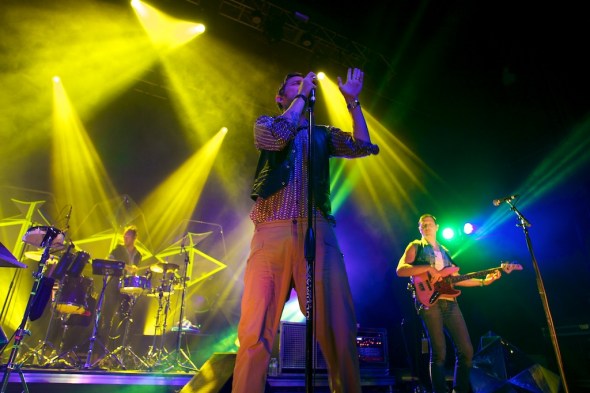
!!! (Chk Chk Chk) go deeper into embracing change and pushing boundaries

chk-chk-chkPhotos by James Nagel // Written by Molly Kish //

Showbams recently sat down with ecstatic party-starters Nic Offer (vocalist) and Mario Andreoni (guitarist) for Chk Chk Chk (!!!) hours before their headlining Noise Pop show. This performance also marked the beginning of touring and support of Chk Chk Chk’s forthcoming 5th LP Thr!!!er.

Offer and Andreoni opened up about creating new jams through a different process, bringing in Spoon drummer/producer Jim Eno to harness a greater focus, and how the new LP is different than prior albums.

READ THE FULL REVIEW FROM THEIR SHOW AT NOISE POP HERE.


chk-chk-chk

Showbams: You guys have been a band now for a little over 17 years now …

Offer: Woah, woah, woah. Jesus, easy there. We’re getting to 17 (laughs). We’re in our 16th year. It’ll be 17 this fall.

Showbams: And you’re noted for somewhat pioneering the dance-punk genre.

Offer: Umm, well yeah. You can hate us or love us for starting it all.

chk-chk-chk

Showbams: You’re also a bit of a staple on the 2013 Noise Pop bill. This isn’t your first time playing the festival, so how is this year’s performance significant?

Andreoni: We have a lot of new jams, a record coming out and different lineup than last time. That’s significant, too.

Offer: Yeah, we were just trying out a brand-new song in soundcheck. You know you write the album, then you have to learn what you wrote. There’s going to be some guess work on stage tonight. But yeah, we were just talking about the Noise Pop’s of yesteryear on the way in and there’s been some really great ones. We’re always up for a San Francisco audience, and at Noise Pop, people usually get down. So, if it’s anything like the other ones, it should be good!

Showbams: Having played various shows, venues, festivals and locations globally at this point in your career, what get’s you most pumped to be on such a lineup as Noise Pop?

Offer: It’s home-ish. You know we’re from Sacramento originally, so there are always a lot of our friends here. Seeing your friends dance in the audience is always a little more exciting. San Francisco is a big deal, it’s quite a town and the festival is just so long-standing. The first time we played it we were like, “Woah, we’re playing Noise Pop.” It’s not like the San Francisco Disco Punk Fest, we’re like, “We’re not Noise Pop …” But, but we are!

chk-chk-chk

Showbams: This is also a show leading up to the release of your fifth album Thr!!!er, coming out April 30th, and you’ve released the free digital download of “Slyd” on www.chkchkchk.net with the prelude of it being “a jam unlike jams we’ve ever done before.” How is it different?

Offer: Whelp, (looks at Andreoni), I’m just going to stop and see if you can answer that question (laughs).

Andreoni: It’s a jam we had never really had. It was sort of this high-level project we had wanted to do. Nic had suggested that we try and do sort of a “Pump Up the Volume”-type of track, and with that, we just kind of took it and ran with it. Nic and I did a lot of the “jamming” with it, and as we were piecing it together, it just felt a lot different than any of the other ways we’ve constructed a song before.

Offer: We wanted it to seem like it was made from a bunch of samples from about seven or eight different songs, like a collage piece that had some sort of center to it. It was a challenge for us. We were like, “Let’s try this and see if we can make it work.” We’ve kind of accepted the whole verse chorus verse chorus thing, so this was like a strange exercise conceptually. It was honestly really fun to work on, not having to tie it together lyrically and to figure out what kind of weird thing would happen next. It was definitely one of the funniest songs I have ever worked on.

Andreoni: So far, some of the initial responses I’ve heard is that it reminded people of Out Hud. Not having been in Out Hud myself …

Offer: You got to realize the dream, finally!

Andreoni: In spirit, there was just some sort of connection there, besides just having members.

chk chk chk

Showbams: I know you guys also recorded the album in a much more tight-knit and disciplined fashion, with help in production and engineering from Jim Eno of Spoon. Was this something that was brought about through having teamed up with him or an effort that you guys went into the studio really focusing on?

Andreoni: I think we needed more of a focus. We kept talking about who was going to be the producer and we happened to be sort of email friends with some of the people in Spoon. Things just kind of came together when we were at South by Southwest, and Nic went to visit Jim and as soon as we all assembled in the studio, we had just a big group focus the entire time we were there. There’s wasn’t a lot of dicking around.

Offer: I felt like we were definitely more disciplined working on this record, but he was definitely the taskmaster. With the six of us, you kind of need someone in charge.

Andreoni: We’ve never had anyone before say like, “This song. Let’s listen to the demo, and this is what I think is possible and let’s focus in on this song.” Before it was more like trying to get takes, assemble things post-recording, see what we can do afterward and how we can freak it out. But this time, everything was, “Let’s get to it right now!”

Offer: Just bottom line, he’s a good producer and it worked. We could feel that type of production, working with a good band.

chk-chk-chk

Showbams: What were some of the easiest and most difficult aspects of working with a fellow musician in this capacity?

Offer: I can honestly say it was one of the easiest records we made. We worked really hard, but the flow of it was good. We disagreed with him about very few things. We did, but it was just like the normal stuff. If you and I were to hang out all night, we would eventually start to have disagreements, but that’s just normal. Everything was cool, in that respect I think it was really easy.

Showbams: Many of the anticipatory descriptions from both the band and critics alike with Thr!!!er allude to it being not like any Chk Chk Chk album before, an effort made by choice to steer away from the “dance-punk” vibe of your previous four albums. What called for the change?

Andreoni: We don’t want to repeat ourselves, and with the way that the material was coming together, we just kind of went with whatever direction we were feeling on the track. The songs just kind of fell together in a different place. Before, a lot of it was that we had this sweet groove that we would just take and build on top of. With this album, there’s a little bit of that and more of a melodic structure.

Offer: Really, nobody’s successful at not changing. There’s AC/DC and Too Short, that’s it! Everyone else who’s still around changes. You have to, and the people who’ve had the longest careers like Bowie, Madonna and Blur, they’ve all changed. I feel like the basis of the group and things that we were excited by were bands that pushed and were new. So, I think we always knew that there was going to be that aspect of the band.

We knew that we would always be playing dance music because that’s how we get hit. When we saw the whole dance-rock thing happen, we knew we were going to be there afterward because it’s just what we like. But we hoped that we could push it so it felt different as well.

Chk-Chk-Chk

SF-based DJ Mike Relm tells us about avoiding the ‘made-to-order whatevers’

Mike-RelmPhotos by Mike Frash // Written by Molly Kish //

I had the pleasure of conducting an intimate hotel interview with Mike Relm while he was on location shooting his Serrato Live “Icon Series” feature. We spoke about his roots as a Daly City DJ, his passion for film and pop culture and his innovative approach to an art form he’s single handedly elevated. Showbams spoke with Relm leading up to his hometown “Ghetto Blaster” tour stop at The Independent in San Francisco.


Mike-Relm

Showbams: Before you became involved in turtabalism and the whole DJ game, did you have any prior musical training/background?

Relm: I mean like for real, for real…not really. Well, when I was younger I played piano for a little bit and then I played trumpet in elementary. But, it wasn’t anything that I took like extremely seriously. You know it was like, “this is what kids do,” probably because I’m Asian. Once that faded I started playing sports and collecting comics, just doing kid stuff, not really thinking about how it was going to effect my life later. I wanted to draw comics for a long time, but then I discovered DJ’ing and movies and thought that this was a little more interesting to me. Then in high school…there was a lot of DJs where I went to school. I don’t know why I thought that was normal.

Showbams: This was out in Daly City, right?

Relm: Yeah, in Daly City for some reason there were a lot of DJ’s. There were crews of them and they had their cool jackets and they got to go to all the parties. I wasn’t like a loner or anything, but I didn’t have a cool “thing.” So I just kind of investigated and figured out that I could do that, it made sense to me. I heard things on the radio and I was like, “okay, how does this guy mix this song into that?” You know I tried it on my cassette deck and I couldn’t figure out how he made it speed up and how the beats matched. I could hear that it was blending, he wasn’t just pressing play and then it was fading on top of each other. I knew there was something going on, I just didn’t know how it was done because I couldn’t see it.

Mike-Relm

So, my brother he knew this other kid who had an older brother who DJ’d and said, “you know he uses turntables.” I was like “Ohhh” because you can slow the platter and manipulate it, you can actually touch the sound. It wasn’t like a reel where you were struggling to match the beats, which made a lot of sense. So I just got more into that and took it kind of like a type of art. Because you know most of the guys who were in the jackets, they didn’t really DJ and were more of the “crew.” They would set up the equipment and stuff and that’s fine, but I wanted to be “the guy!” I wanted to be the one mixing and scratching, which is kind of how it all started. It was such a young art form, and it still is. There was just so much to learn and discover in it.

Showbams: Are you innately drawn to or put off by any certain genre of music when putting together your mix-tapes and mash-ups?

Relm: Definitely hip-hop, obviously that’s where I started. Dance is pretty easy to mash stuff up on because it has a very consistent quality. Like classical has different time signatures, so if your trying to make like a 4-4 beat of it, you have to kind of edit it and repeat or drop things out. You’re not forcing it if you’re doing it right, but you have to sort of massage it a little bit to make it work.

I tend to gravitate towards beats with swing. It doesn’t have to ba a jazz swing or rock swing, it just has to work. There are so many samples, that you’re like “that’s such a cool sound, but why is he doing that?” Or “how can I make it work,” or “this would sound good if this was done with it.” What I’m drawn to isn’t necessarily perfect sounding or in my mind feels complete because then, what am I going to do with it? There are some songs that are amazing but I don’t want to touch them. Yeah like I’ll listen to it, but I don’t want to do anything to it, because I like it so much.

Mike-Relm

Showbams: Are you ever able to turn off this type of innate re-mixing while listening to music, or is it something that is constantly going on in your head?

Relm: I can’t and I’m not trying to. It’s not like “OH GOD, TURN OFF THE NOISE.” It’s great, that’s how I enjoy things. I’m definitely not like a lyrics first person. I listen to a song and just kind of dissect it sonically. I love organ chords, something about them just feels epic! I also can tell when “oh that person listened to this other song and maybe they liked it so much they just wanted to make it their own version.” Which is great, but I definitely listen to things actively and I don’t remember lyrics too well. When other people are singing along to a pretty popular song, I find myself thinking, “Woah, I don’t know this song.” I know how it goes, where it goes and I know the drum rolls and everything but I don’t know what they’re saying. I’m not completely deaf, I’ll know enough but it’s kind of cool because going into film and television, it helped me look at that in a totally different way. I really enjoy movies, but I look at them as samples. I’m listening, paying attention to the editing and watching to see if I could use it for something.

Mike-Relm

Showbams: You were going to SF State and studying film when your career as a turntablist really started taking off. Was it always your intention to have your background in cinema play such a large roll in the type of work you produced, or was it just naturally what your interests developed into?

Relm: Kind of both, I didn’t know that I could DJ for this long. Back then a couple guys were doing it and it was either you could be the crazy guy and take a chance scratching for a living or you could play it safe and Dj at a club. Not that DJing was a safe career compared to like a business person or something that has a 401K, but for me those were the two options that were laid out at the time.

As time went on though I was pretty lucky because when I was doing the scratch battles, it was probably at the peak of when you could have been doing it. Now there are so many contests that have come and gone, that it doesn’t mean as much. I was going to school and studying film which is what I really wanted to do, but now I can combine both. It was the way the technology worked out…

Mike-Relm

Showbams: The timing was perfect really.

Relm: Yeah, I got really extremely lucky, I was in the sweet spot for doing that. If I had started a little later as a DJ, I probably wouldn’t really understand a lot of the things. It’s like a photographer who starts shooting on film, they understand lighting far greater then someone who starts on digital. They’re like, “I can see it, I can see things going on,” but your backgrounds blown out, change your F-stop! When they got to digital, they just understand it better, they can apply the same effects to digital. The same thing applies to vinyl, serrato scratch live and those programs, it’s analogous. You can throw somebody in straight digital and they’ll be fine, but there’s certain things that you just kind of pick up that you can teach, but it’s very tough to translate. I can tell kids, you know like we used to scratch when the sounds were actually on the record. They’re all, “but that doesn’t make sense, but the waveforms they’re all here?” I’m all, “we didn’t have waveforms, you had to like LISTEN TO IT to match the beats.”

Showbams: I know that your shows have a lot of multimedia and video aspects in them. Do you have any directors or film composers that you draw influence from?

Relm: I guess from the beginning it was always Tarentino and Michel Gondry. The way Tarentino does his films are already like re-mixes. You can hear it in the dialogue and see it in the way he sets up the scenes. A lot of people think he is just ripping off others, but he’s not. Really, everything’s a re-mix. Anything anyone has ever done, you know like Craigslist, is a re-mix of a newspaper! Nothing is completely original anymore. Not to say that we are less human beings than the generation before, but they got influenced by others as well.

The way I set my show up is different in that I’m not the “yeah, ya’ll put your hands up” guy, I’m not “that guy!” That’s just not me. One of the lessons I’ve taken from Tarentino is that in his films he never really lets you forget that you’re watching a movie. He’s not trying to to be like, “you’re in a different world now,” it’s like no, you’re watching a movie. That’s kind of the way I do my live show, I’m not trying to make you think that you’re anywhere else except a box where there’s loud music, a screen and lights. I like to have that kind of communication. As for scores, Elfman, ever since I was a kid I was like okay, that guy can do no wrong!

Mike-Relm

Showbams: As an artist where most of your work draws from well known samples and copy-written material, what are some of the barriers you face with distribution and marketing?

Relm: Distribution channels are definitely different if you’re doing it the way I am. You can’t just press up blue ray copies of whatever I’m doing and sell it at Best Buy. But there are so many other channels now that are available. Before it was just me putting the files up on my website and you could watch it there. Now there’s YouTube, but even in that as you gain more popularity it gets challenging. I’m not completely under the radar anymore like in the beginning when I would just be doing a lot of art shows and stuff. Where it was like “Oh, there’s this guy doing this cool new thing where he’s scratching video.” And earlier the art community really embraced it, they’re always kind of first anyways, because I think they understood kind of what I was doing. It was interesting to me, that’s why I did it.

I think as time went on, I wouldn’t say my approach became more mainstream but it cast a wider net. I wasn’t trying to take like crazy “found footage” and do something with it. I wanted to work with things that people recognize, that’s part of the fun! There’s a huge learning curve, even within my shows when I take something that people are unfamiliar with and doing something with it, because they don’t know what’s being done. But if I work with something like The Peanuts or Led Zeppelin, they know what it’s originally supposed to look like. Then when they see what’s being done with it, they’re like “Oh, oh that’s, I get it!” I don’t have to sit there and explain like, “Okay guys, so I have this record and this record controls the files…” nah, I don’t want that. Then it cuts the umbilical chord of the show. I don’t want them to have to sit and intellectualize it too hard. That doesn’t make for an entertaining time.

Mike-Relm

Showbams: You play off “the association” and people can connect on that level too, in which they can appreciate you creatively tweaking something they’re familiar with.

Relm: You always get the like, “Oh, I remember that,” or “Oh, I get that one!” That even comes with being a DJ, because we do that with songs. With copy write, I don’t know, I guess I’m pretty lucky with that as well. I don’t make a piece for a show and think, “huh, am I going to get in trouble for this,” because if so, I would never do anything! When I first started DJ’ing, people would ask me like, “how do you get permission to play the songs?” I’d be like, “What?! I’m just playing a song, what are you talking about?” I guess it’s a little different now, but what it comes down to is that no one is watching my show thinking “well he did this thing with Office Space, I was going to buy it on Blu-Ray, but I’m good.” No, why would you do that?

Mike-Relm

Showbams: Beyond creating mix-tapes and sampling for your live show, you wear several other creative hats as a director of commercials, producer of short films and re-mixer of pop culture events and full length movies. How do you go about choosing the content that you work with in such facets?

Relm: Just kind of goes back to how I listen to things. Hearing music as a teenager, I used to take in a song and store it in my mental library under things I want to play or scratch with or re-mix. That’s kind of how I do everything now. I’m trained so that even when I watch TV, I feel like I need to go find these soundbites or re-watch that clip. Like I just did a Key and Pele re-mix and that was simply due to the fact that I liked the show. I saw that sketch and it was so musical how they were doing it. I just thought, I’m going to make it more musical.

There’s so much going on in media and entertainment, it’s not hard. I used to just take cult things. That was my deal, and you couldn’t hate on that. But now, you can do things with pop culture and put a different spin on it, and it’s almost less corny. Like you can watch Honey Boo Boo the TV show, and my remix is not as corny but still kind of funny. Part of it is taking guilty pleasures, I don’t know…

Showbams: Are you watching something for instance and just have that moment where you’re like “Aha!”?

Relm: It is very “Aha!” Like I’ll be watching something from TMZ, and a day later people will send it to me and tell me I should re-mix it. But it’s not the same, the humor won’t be there. Because it sort of is my voice, there is a genuine quality to it where as even if it is Honey Boo Boo/Gangam Style, it has to come from me. It’s weird because you can’t quantify it like, I can’t make a list where these are the things that make me want to re-mix something and you can go do this now. Which I think is the way it should be with everybody.

Because if you’re not you’re just doing “made-to-order whatevers.” I know people that are working on videos or something and they have a checklist?! I’m like, “why do you have that,” can’t you just go listen to stuff and watch things, you’re supposed to enjoy what you do. Even when I’m doing my movie trailers and things like that, I’m not trying to make fun of anybody. I just think okay, how can I elevate the energy of this? But, when it’s pop culture I can take a few more comedic liberties with things. It just really comes down to what your voice is I guess.

Mike-Relm

Showbams: Have there ever been any directors or producers of the material you are working with contact you after seeing your re-mixes of their work?

Relm: Yeah, a lot of them do and because I’m not making fun of them. I’m fans of the things I re-mix. Like Jon Favreau liked the Iron Man thing I did, and Edgar Write liked the Scott Pilgrim thing I did. Those were early on before I started doing things directly with the studios and filmmakers. It was just me doing it because I liked it. That was extremely cool! You could see people were watching it, but you didn’t know who. They were just numbers that were racking up and I was like “Hey a lot of people are watching this, what should I do next?”

Then all of the sudden you get a tweet from Favreau or Write and they could’ve gone either way. They could have said, “take this shit down dude, this is mine.” But they’re were like no, this is cool, do another one or what else you got, this is interesting. Which says a lot about filmmakers too, because your first assumption would be “ah man here it is, here’s the take down notice.” But, it’s not, and I think that there are people like that, and the people who want to act that way just kind of don’t get it.

Unless I’m pissing on it, you know like taking their work and drawing bunny ears and penises on it, that’s just disrespectful and you have every right to take that down. I’m trying to basically in my own way promote their film, because I like it and that’s my tribute to it. As long as that comes through, it’s a good thing, because I actually care about the stuff. It is very cool when they come back and say, “this is dope.”

Mike-Relm

Showbams: Currently you’re in SF filming a project right now. Could you elaborate on it?

Relm: I’m shooting with Serrato. They have something they call “The Icon Series” which are features on people who use the software and embrace it, focusing on what it is about the individuals that makes them special. When you’re looking at gear in general, it can get dry, like “oh, this gear changed my life, because I used to use this, now I use this, see!” Yes of course, it’s technology which gets better, so yeah, this thing replaced that. Buy a new car!

It get’s kind of predictable, so what they’re doing is interesting, not only because I’m a part of it but I like biographies, like the old school Ted Talks, where you can be like “wow that guy is really saying something.” You have designers who aren’t talking about how they use Photoshop but rather the thought process and theories. That’s kind of what they’re doing but in a shorter package. They’re beautifully shot, everyone looks great in it, so yeah I’m excited!

Gemini Club reflect on implementing technology for successful benefits

Gemini ClubPhotos by Maggie Corwin // Written by Molly Kish //

Showbams interviewed Tom Gavlin and Gordon Bramli from Gemini Club before their show on January 17th at Rickshaw Stop in San Francisco. Recognized for their modified audio techniques and improvisational live performances, Gemini Club thrives in a state of chaos, which they claim is imperative to their success. The band’s been a topic of interest on several indie blogs and music websites and has been a consistent recommendation from my colleagues.

They took the stage in SF, playing to a sold-out Popscene audience suited for battle with an armada of franken-synths and an attitude to match. Before blowing the minds of a fully packed Rickshaw Stop that evening, I got a chance to talk with both Tom and Gordon about what makes their band “scary,” in a good way.


Gemini Club

Showbams: Tom, I know that you met Dan back in college at Columbia where you bonded over electronic music, shared demos back and forth and eventually met Gordon and got him on board for live shows. What type of projects were you guys working on pre-Gemini Club?

Gavlin: We were in a band together, called the Balkans. It was really straight forward: two guitars, a synthesizer, bass and drums. I was a very bad guitar player then, so they we were like “maybe we could just go as a four piece” and I was like “okay.” Then I got into electronic music on my own. I started making demos, and Dan and I had a politics class together. When I had showed him my demo. He was like, “this is good, I like this a lot!” Dan was really getting into electronic music and wanting to do that so he decided to one up me with his own demo, and a week later we we’re at his house up really late, putting some vocals to it and just haven’t stopped.

Gemini Club

Showbams: Gordon, at that time you were doing your own kind of DJ stuff. Were you ever trying to spin in an indie medium or was it something completely different?

Bramli: Yeah, well I had a night at this bar and I was hosting it as well as DJing. It was through friends that I heard Dan and booked him. He DJ’d, and I liked what I saw. Then one day he was like “come over” and he played me some Gemini Club, the early tracks. I enjoyed what I was hearing. He asked me if I wanted to be in the band and I said yes right away.

Showbams: From conception, was the live performance something you all agreed upon would be the main focus of the band, or was it something that just naturally evolved?

Gavlin: To a certain extent, it all starts in the studios with the songs first. Then we figure out how to re-create them live in a way that’s genuine and utilizes to the utmost extent the technology that we implement in our shows. We knew we had the capabilities of exploiting that technology and making it cool. When I say “cool,” it’s because I can sit and bore you for twenty minutes about the complexities of the things that are going on, none of which I do because it scares me. Dan’s rig scares me!

Gemini Club

Showbams: Your live shows are unique, not only in the equipment, but also material and consistently changing nature of your performance. A lot of which has to do with the type of audio tools you’re using, most notably the Gemini Rig. Can you explain what a “rig” is?

Gavlin: So there’s two rigs in the band, Dan has one and Gordon has the other. Baisically we run Ableton Live, and I have an APC 40 and innovation keyboard, and I do samples and beats. With that I am Midi clocked to Dan and he plays the synthesizer and guitar.

I have the master clock and can effect his piano playing, make effects on it and everything. We tilt our gear towards the audience, so they can see what were doing live and it’s very versitile. Each song we can change parts and re-sample, it’s a lot of fun.

Gemini Club

Showbams: Beyond that, you guys also play with another piece of equipment called the Gemini Capsule …

Bramli: So, that’s an eight-step sequencer synthesizer that we’re building with a company called Unitronix, from Chicago. It’s all bulit in Chicago and we’re super proud of it. We’re actually going to launch it this year, right around SXSW.

Showbams: I know this type of equipment allows you to do on the fly re-mixes, which personalizes the experience for audiences on a nightly basis. Conversely though, this makes for a very rigorous tour schedule and is something most bands would shy away from. Do you ever wish that maybe you would of stuck with a simpler set up?

Gavlin: Sure you know, maybe we should’ve stuck to horses instead of making cars. No, not at all.

Gemini Club

Showbams: Is it in anyway nerve-wracking to incorporate such an improv element?

Gavlin: Yes, the rigs scare me … there have been panic attacks during soundchecks (laughs). Today, I had to walk away and do something else. Yes, it’s very scary!

Bramli: The rewards of it being difficult and the element of failure is really important to us, because we thrive on taking such risks. Because when we do succeed, it means that much more to us. It’s real.

Gavlin: Like we were saying, we use this type of equipment for it’s benefits, not to make it easier. People talk about backing tracks and launching clips … however the hell you feel about it, everybody does that! I’m not saying like everyone at some folk festival would do it but it’s you know, how you do it! Do you make it interesting?

Gemini Club

Showbams: Has there ever been a moment that things didn’t pan out the way you had hoped them to?

Bramli: (Laughs) Many times … all the time!

Gavlin: I’ll never forget the time that we were playing in our earlier days when I pulled out a cable, trying to climb up a ladder on a stage and I completely unplugged Gordon’s APC. Which means the music stops. I mean we’ve probably had a good dozen moments where a computer crashes.

During a sold-out show at Lincoln Hall, Gordon’s APC, which normally scrolls through clips as the set progresses, started scrolling on it’s own. I saw this at practice and was like “this is weird,” but figured it’s a bug and takes about two minutes to fix itself. This happened like two days before, and I was OK with it, two minutes we could work with. So playing live, I look over and see the screen scrolling. I’m thinking, okay two minutes I can just chit chat and make jokes. It ended up however, feeling a lot longer.

Bramli: Meanwhile, I’m frantically rebooting, sweating, dying!

Gavlin: But we managed. Once we fixed it and got back on stage, no one even noticed. It was a good feeling! It’s like being sick. I’ve been sick for two days and you just deal with it. You either let it break you down or have it build you up. You learn or quit.

Gemini Club

Showbams: Since 2009, you’ve put out two albums and are currently starting the West Coast leg of your tour, debuting new material throughout. In your blog, you allude to a full-length album in the works. When can we expect more info regarding such?

Gavlin: Yes, we’re working on a full-length record now. We have five tracks written and are playing three of them tonight. We are going into the studio in February following that, and I would expect new music in early summer after South by Southwest.

Gemini Club


After we talked, the guys gushed about how they loved SF “more than they like most people.” They shared stories of their road trip to Sausalito with the founder of Tellason denim and their love/hate relationship with the Midwest.

They’ll be finishing their tour up back at home in early March, diving straight into completing their heavily anticipated full length. After catching their performance at Rickshaw Stop, my prediction is that the boys will be scheduling a return visit out here for festival season.

Foxygen reveal influences, prolific production pace

FoxygenWritten by Molly Kish //

We interviewed the duo behind LA indie-rock band Foxygen before their show at Brick & Mortar Music Hall in San Francisco as Sam France (vocals) and Jonathan Rado (guitar, keyboards) sat down with us for a conversation about how their partnership has developed and why they’re big fans of Richard Swift.

The band was on tour promoting their 2012 EP Take the Kids Off Broadway with its third studio album We Are the 21st Century Ambassadors of Peace & Magic set to be released on January 22nd.


Foxygen

Showbams: While still in high school, you guys formed the band back in 2005 as result of a common interest in The Dandy Warhols and Brian Jonestown Massacre. Do you feel these bands play a part in the overall Foxygen sound and the type of music you currently are producing?

Rado: I’d say more so Brain Jonestown Massacre than The Dandy Warhols. I don’t want to bash the Dandies, but we were really into the Brian Jonestown Massacre.

Showbams: As multi-intrumentalists, how many different ones do you play, and do they all make it onto your records?

France: I’d say pretty much every single instrument that we know how to play is on the album, except for maybe sitar. We definitely can adapt to most any instrument between the both of us.

Rado: We play pretty much every single instrument ever (laughs). It’s all in there.

Showbams: While in school you guys recorded a bunch of material and distributed in a very DIY manner. Did any of that make it on the LP or new album?

Rado: Most of the earlier efforts were written while we were both in college and in different places. We were writing songs away from each other and then later came together and recorded it. Nothing from the high school years made it onto the LP or album, but there is a huge back uncatalogued that someday will probably come out.

foxygen3

Showbams: How difficult was it to develop an album while on completely different coasts?

Rado: I had quit college, and we were living together in New York during that time. We just worked on it for months. Everything down to little sounds and nuances, it just became our life for a little while. Although we wrote it in different places, we were able to record it together, so technically it wasn’t as bi-coastal as the press makes it out to be. While still attending, I would go to school and come back and Sam will have been, some days just tampering with about 30 seconds worth of recording. The album took about seven months for us to make or something like that.

Showbams: During that time, I know you guys both played in other bands and still were doing separate things musically. Was this project just simply the one that worked the best for both of you?

Rado: It was never really a question. You know we did other things, like I was a hired piano player for some chick. Sam was in kind of a funk band (laughs). But it never really made sense to do anything other than Foxygen.

Showbams: Upon completion of the album, did you guys know that this was “the one,” as in the one that was going to take you to the next level career-wise?

Rado: We definitely never counted on getting signed because of it, or anything like that. But I think whenever we make an album, we kind of have the attitude like, “This is it, this is the album.” Sam and I don’t really know much about anything but making albums, and we’ve always just done it. I don’t think we started making it with any sort of intent, other than to just make it, and we gave it to one person.

Foxygen

Showbams: Were you guys fans of Jagjaguwar before getting signed? Was giving their contact the record an intentional move, with the hopes of potentially getting the type of response you did?

Rado: I wouldn’t say we were fans of the label as much as we were fans of Richard Swift. We loved him more than anything, and I still think he is one of the most legitimate people working within the industry. I knew of the label, and that they would kind of like it if they had heard it, but ultimately we just needed to give it to Richard Swift. That was the main goal.

Showbams: He ultimately helped you guys produce and add the finishing touches to the album in the long run, didn’t he?

France: Yeah, we gave him all of the thousands of overdubs, and he somehow took them and mixed them into what you hear today. He’s genius!

Showbams: What’s next for you guys? What would you ideally like to see transpire in this upcoming year?

Rado: I don’t know if we’re allowed to say this yet, but I don’t care. We already have an album done that we did with Richard Swift that’s coming out next year some time. We just started working on the next one after that and already are drawing out plans for the one following that.

Stagnant Pools present a unique sound through sibling chemistry

Stagnant-Pools
Written by Molly Kish //

Showbams caught up with Bryan Enas (vocals, guitar) from two-piece band Stagnant Pools, which have drawn comparisons to early noise-rock/post-punk groups such as Sonic Youth and Joy Division.


Showbams: From Bloomington, Ind., Stagnant Pools is a stripped-down rock band made up of you and your brother Doug. You are on vocals and play guitar, while Doug plays the drums. Growing up together, were you two always involved in music as a pair?

Enas: Our dad was a musician, so growing up we had instruments around the house. We played with our own friends for a while and when we both got into high school, we had a five piece indie band. I played bass and Doug was still on drums, but I didn’t learn to play the guitar until I was in college. I just taught myself. I can’t read music, so I just went off of what I knew from bass for a couple years.

Then, when I was off in college and Doug was still in high school in Indianapolis, which is like an hour away in Bloomington, I was getting introduced to a lot of people and the music they listened to. Stagnant Pools started when I learned to play the guitar and wanted to write songs in the direction that was very different than the material we played in the bands we were involved in.

Showbams: Was the ultimate goal to have a two-person outfit?

Enas: When we started we were never for or against being a two-piece band. Doug was the only person I knew that played music and was interested in the kind of sound I started to mess around with. While playing guitar, I wrote one song, went home for a weekend and self-recorded it. Then we kind of just went from there. We’ve never been opposed to adding anybody, but we just feel like we have a good chemistry and stuck with it.

Showbams: Whereas some people may find it hard to work with a sibling, you two seem to have a pretty symbiotic flow together.

Enas: Yeah, we’re not very egotistical people. Our ideas for songs are pretty straight forward and we kind of both have to be “about it.” If we’re working on a song and one of us isn’t feeling it, then we don’t mess around with the song any more. We both want to be on the same page and being brothers kind of helps. We never get into arguments about creating songs.

Stagnant-Pools

Showbams: Your sound is described as having a heavy drone, almost having a shoe-gaze feel to it, in the vein of early Disappears and Joy Division. Would you say these are accurate comparisons?

Enas: I’ve listened to those bands and they’re good. We really try and listen to all types of music, even more so not stereotypical rock music. We both listen to a lot of jazz, dub and reggae. As far as the music that we play, I can see why those bands are mentioned, but our sound really is just kind of what we want to play. If it resembles a band of the past or a current band, we’ve both listened to those bands and we’re not going to deny that. I more so try to personally find out how bands we don’t resemble influence us. Like how an African Fugi band or music that doesn’t “sound like us” get’s into our music.

Showbams: After having put out a couple efforts on your own, you guys signed to Polyvinyl this past May and were able to release Temporary Room two months later. Was the album already complete?

Enas: The album was ready in 2011, we had worked on it that summer. We only had one day in the studio to do it, but as far as mixing goes it was mastered in September. We then got hooked up with Undertow Music Collective, who manages us, and they are based out of the same town as Polyvinyl, Champagne, Illinois. So when the time came to shop the record around, they knew people at the label on a friendly basis rather than business partners, and they just happened to be willing to help us out.

We were really fortunate for that, and they’ve all been great. They really are the nicest people working over at Polyvinyl. We felt comfortable right away and went directly to Champagne to meet them just to hang out. I think the first time we met people from the label, we didn’t even talk about the record all that much. We don’t really know much about the music business, so we were glad that our footstep into that world didn’t really seem like a major label situation like you’d see in a film. For a new band with no history or involvement touring outside the Midwest or with other labels, there’s a lot of groundwork they helped out with, so that the record could be released in a timely fashion.

Stagnant-Pools

Showbams: In support of the album you guys have toured the country, played a couple festivals, have opened for numerous big name headliners and have received a bunch of praise from indie outlets such as Daytrotter, Consequence of Sound, Pitchfork and Paste Magazine. Did you ever imagine the record to take off so immediately?

Enas: No, I never imagined. It all seemed to have happened pretty fast. We have a great publicist at Polyvinyl, and I think just the reputation of the label helped when our record was going a ground. Polyvinyl doesn’t sign bands on a whim, and their roster is fairly moderate in comparison to some other major independent labels.

At first, it was sort of exciting to see press stuff about the album, since we’ve been sitting on it for a year. We had such anticipation to see what people would say, because we knew how we felt about it for a long time. It wasn’t even in vein, like we wanted to get the best ratings or anything. After holding on to it for as long as we did, we were just excited to hear what other people would think. I’m not sure what the next album release will feel like, but it definitely was exciting when Temporary Room came out.

Showbams: You guys are pretty active via your social media accounts, mainly through Facebook and Twitter. As a younger band, how do you feel this type of medium has positively or negatively affected your success?

Well, I think social media is kind of a double-edged sword. It’s great because people across the country can hear your record. Sometimes I’ll get a message from a fan in Central Europe or South America, and it’s crazy to think that something you made has reached someone several thousands of miles away.

On the flip side of that though, I feel like people nowadays tend to be more impatient with bands and giving them a shot. Like back before the Internet and being able to hear bands online, you had to actually go and show up at a venue, pay to get in, hear them and go off of that. Now, you can hear a whole band’s album on BandCamp or something like that, and it’s really easy to listen to the first five seconds of a song and write a band off. That’s why I think it’s a double-edged sword. There’s a type of immediacy that comes along with those mediums, which has its up and downs but the same can’t be said for music back in the day pre-Internet.

Feeling the ‘Janxta Funk’ spirit with The Pimps of Joytime

Pimps-of-JoytimePhotos by Mike Frash // Written by Molly Kish //

Showbams interviewed Pimps of Joytime bandleader Brian J on December 30th after the group’s performance in San Francisco at The Fillmore.


Showbams: Currently you’re on tour promoting Janxta funk, both the album and the ideology, which you describe as part gangsta and part janky. Can you elaborate a little more on that?

Brian: Yeah, you know it’s kind of a vibe thing. You’ve got the gansta’ part which is the style and the janky, in that it’s a little rugged. That’s the way we roll you know, not everything is perfect. Sometimes the door comes off the hinge or you gotta make it to the gig and you get a flat tire. The operation’s a little bit janky, but you just gotta spin it and make it positive. We call it Janxta.

Pimps-of-Joytime

Showbams: Your influences draw a lot from the live music and DJ scene of your hometown Brooklyn, New York where you guys emerged from initially. Who were some of the artists that inspired your sound and live performance?

Brian: Certainly a bunch of the DJ’s out there like Nicodemus, DJ Concern, Monk One, Chico Man. There are so many great bands. We just collaborated with Alex from Rubblebucket on a song that should be on the new record — they’re doing a lot of good stuff. Also, everyone in the Pimps has other really great projects, like Mayteana has Stereo Fights, Cole has That’s My Cole, David Balis has Baja and the Dry Eye Crew and Eric plays with Ander’s Osborne. You know, so everybody’s doing their thing.

Pimps-of-Joytime

Showbams: On the new album, you also are featuring working with both the Neville Brothers and Roy Ayers. Having spent some time in New Orleans Brian, was this something you always wanted to do?

New Orleans music has a big influence on me, and just the energy of that city I have a connection with. For me it’s a spiritual home, although Brooklyn is where I’m from, spiritually I just love New Orleans. The artists are just so talented and soulful. Getting to work with Ceril, after we collaborated on a song on my first record High Steppin, he called me to produce his record Brand New Blues, which was really cool.

When we were working on that I had him sing on a couple Pimps things and I just threw it in the session. Kind of the same thing happened with Art Neville. He was recording on Ceril’s album and I was like “Hey could you record on mine?” He was like, “I tell you what, you come over and if you can fix my computer I’ll do it.” So we did a little trade, I came over and helped him set up his computer and I got to hang out all day. We ate po’ boys and he was telling me stories about The Meters. It was cool. It was a special day.

Pimps-of-Joytime

Showbams: The New Orleans culture is really prevalent in the Pimps stage presence, and the band is known to bring a big sound and infectious funk to your live performances. How have the crowds responded to the new album’s material while on tour?

Brian: It’s been steadily growing. You know we do a good show, then everybody at that show tells a few people and the next time we come around, there’s larger crowds. The good ol’ fashion word of mouth type thing, pretty much how we’ve been doing it.

Showbams: Has there been any particular show or venue that was more difficult to play than others?

Brian: Yeah, we’ve done some challenging gigs. Like a couple times when going through Colorado in the winter, having to play outside. Promoters don’t understand that when you play music you can’t wear a heavy jacket and big ol’ gloves, they don’t quite get that so … They’re like, “What’s a matter, everybody else is outside?” A couple of those were kind of tough, and you know you just gotta take the good with the bad.

Pimps-of-Joytime

Showbams: You guys have a very rigorous tour schedule. How do you respond to constant travelling and performing?

Brian: Well, we have an expression, that if something is really difficult, we call it “character building.” So, if somebody’s like, “How was the show?” We’re all, “It was character building.” (laughs)

Showbams: Conversely, what’s your ideal show or best outcome when walking off stage?

Brian: It’s a combination of me loving the sound that myself and the band’s making and the crowd’s really receiving it, when we get that energy flow going. I love when people have a great time and they love the show, but the best is when I love it, too. There are different levels on different nights, but sometimes the spirit really hits, and everybody’s in the vibe. That’s just a magical thing!

Pimps-of-Joytime

Showbams: After the show, you guys are headed to play the Black and White Ball for New Year’s Eve in Nevada. And on that trip, do you have any resolutions or plans for 2013?

Brian: I’m always, and I think I can say this for everybody in the band, we’re spiritual people and always trying to work on ourselves to become better people on multiple levels, and I’m going to continue to do that. But, I think I need to get a little more in shape, so I started playing tennis and have been working out a little bit. It’s pretty common, and probably the most broken resolution ever.

We also got a new record in the works that I think is going to be the best, most cohesive record to date. It has really good songs, singing and great playing. I recorded it in a different way and did the rhythm section live, which I’ve never done before. It’s going to be our best record, so I’m going to put it out there in the world and be like, “Here, here you go!” and see what happens.

Pimps-of-Joytime

D.A.M.B. talks production, birthday songs and ‘That Tessa Track’ EP

D.A.M.B
Written by Sean Little //

D.A.M.B., aka Shaun Slaughter and aka Leron Hubbard, is a producer from Sacramento, Calif., who I had the privilege to perform with recently. His style brings heat to the party, and his production is pushing a lot of boundaries with interesting samples and deep bass.

He’s signed to Tracey Recordings, Le Heat and No Brainer and can be found blowing up parties with Lights Down Low, Heater House of Bass every second Friday at Townhouse and Whip on every fourth Friday at Townhouse.

Showbams sat down with Slaughter to learn a bit more about him as a DJ/producer and how he’s evolved as both. We also spoke a bit about his brand-new That Tessa Track EP.


Showbams: Thanks for taking the time to answer a few questions. You both DJ and produce tracks, what came first? How did you get into each?

Slaughter: DJing came first. I started in ’98, mostly house music and from there I started making unsolicited edits, extended players, remixes in 2005 and eventually my old DJ partner bought me a decent midi controller and basically said “Dude, GO MAKE YOUR OWN SHIT!” From there I started making tracks and sending them to pals to criticize and give feedback ‘til I got it right. I sent my second attempt “Waiting” to my pal Larry Tee and he was WAY stoked on it, and he talked to Alexander Technique at DANR Records and got it signed. Sinden featured it on some Mag Mix CD and shit started rolling. Definitely was validation enough to keep at it.

Showbams: Being both a DJ and a producer, how do you feel that each affects the other? Do you produce songs with the crowd in mind hoping for a specific reaction, or do you use DJ sets as inspiration to go back and produce a track that you feel captures the vibe of the crowds you’re used to playing for?

Slaughter: I have a really weird process of writing music. I never come into a project with too much in mind. I usually just start building drums and find some random samples to use, and then I see where it goes. It’s kind of awesome creatively because it’s SO random, but incredibly hard when trying to build your sound and signature as a producer. I’d imagine my tracks are a pretty great example of how my brain works, hahaha, but yeah, I mean, I DJ house nights, and I will probably keep the D.A.M.B. stuff in that general arena.

D.A.M.B

Showbams: How did you get started in the DJ/production world, and what’s it been like to grow as an artist and producer at a time when it seems that so much is happening so quickly (personal production pace, other producers emerging, new genres popping up) in the scene?

Slaughter: I lived with a girl for a bit who was a trance DJ and had turntables at her place. I’d wake up and fuck around with them when she left for work, which is how the ball started rolling. Eventually I got the bug to throw parties AND DJ them….mostly all the French touch stuff that was really blowing up late 90s. Fast forward a few years and here we are today.

It’s been a pretty rad experience so far. I’m incredibly impatient, so honestly, things don’t really feel like they’re moving fast. The whole process of writing, mastering, label shit etc. has taught me patience for sure. In terms of how the production etc. is evolving as a whole, I guess it’s pretty amazing that any young producer with a laptop can sit down and hash out a track in the matter of hours without a huge, elaborate studio. In regards to new genres, most of that shit is kind of annoying honestly. So many kids are flipping styles SO much. Moombahton one day, trap the next day, deep house, then tech house then etc. etc. etc. I guess it all just seems so fleeting so I try and ignore it.

D.A.M.B.

Showbams: You just dropped That Tessa Track EP, and I really dig a lot of the songs and sounds (even sneakers squeaking on a basketball court in March Madness) you used. It’s minimal, but has a unique style to it that I can definitely see blowing it up during a live mix. What track from it means the most to you, and which do you see getting the biggest/best response from crowds?

Slaughter: I definitely like March Madness the best. The samples worked out really well together. That Tessa Track came from a jokey booty-bass song I made for my pal Tessa’s birthday, but I ended up liking the drums so much I filled it out and shopped it around. The original song had a really embarrassing sample of me saying, “Tessa, its yer birthday” over and over on it. The track that does the best out for me is “Train Hopping”. It’s just a solid builder and sort of a gimmicky break (sounds like the soundtrack to Abyss) people seem to lose it the most to that one.

Showbams: When creating That Tessa Track EP what other producers or genres did you look to for inspiration? What was the creative process like for this EP?

Slaughter: Dirty Bird. They are like fucking scientists of bass. I do not get it! My creative process is as follows: Pot, Soda, Wasabi Party Mix, Repeat.

Showbams: What are you most excited about right now in dance music, whether it’s producers, genres or emerging scenes?

I really like the Dirty Bird stuff house-wise, but for me right now, Zombie Nation is genius production wise, like mind-blowing jams off his new record.

Showbams: What are your top five tracks right now?

Zombie Nation: “Level”
Ejeca: “Riddim”
Amtrac: “Metro”
Super Flu & Andhim: “Scuzzlebutt”
Dabin: “Awakening (Kwikfiks Remix)”

Showbams: What’s up next for D.A.M.B., both on the performance and production fronts?

Slaughter: I have the Alicia EP out on Tracey Recording in March and a new EP from my other project, Leron Hubbard, on Teenage Riot on February 12th. Performance-wise, I’m working on doing a really elaborate visual show to go with my set at a club here in Sacramento. Something more like an art installation and something more engrossing than watching me press play on CDJS

Check out D.A.M.B.’s new Tessa Track Promo Mix and his That Tessa Track EP preview here. You can also check out his Facebook for updates and show schedules.

Charles Bradley tells us how he turned heartache, pain into his dream

Charles-BradleyPhotos by Pete Mauch // Written by Molly Kish //

Showbams spoke with funk/soul/R&B singer Charles Bradley after his set at Outside Lands.


Showbams: Coming off of an amazing performance here this morning, how was it for you to play the main stage of Outside Lands?

Bradley: It’s beautiful. I thank everyone for the opportunity of giving me a chance to get out and show the love I’ve got to give.

Showbams: I know you have a special pre-music career connection to the Bay Area, in reference to your professional background as a chef for nearly 20 years.

Charles-Bradley

Bradley: Right, I was cooking for 1,000 people down in Menlo Park in the San Francisco area, and then when I moved to upstate New York, I was cooking for 3,500 people a day. When the job called, I took up cooking. Starting off as the assistant cook, and I just kept going and going. I was really just trying to prove to the world, to just give me a chance and that I really wanted to do it.

Showbams: Also, when you went back to New York that first time, during the “Black Velvet” phase, you were a handyman as well. You’re quite the jack of all trades.

Charles-Bradley

Bradley: You know what I learned from being a carpenter? You know, Jesus was a carpenter, and he said to build your cross and follow me. That’s why I liked being a carpenter. When things were going wrong and I was saying that I can’t make no money in an honest way, I always remember what Jesus said.

Showbams: It was during this time that you made contacts at Daptone Records, got acquainted with The Sugarmen Three and had your fateful run-in with Thomas Brennick and The Bullets, which served as a very pivotal moment in your career. Was it all by chance that you were able to land these meetings, or was it a calculated professional move?

Bradley: I think that Tom made a lot of things happen for me because he knew I was a mourning sensation at that point. I was going through hardships in my heart because I had just lost my brother, and Tommy invited me over to his apartment in Brooklyn where we just started talking. I thought I would tell him about my pain in losing my brother, and he told me that I should put it in front of music. I told him, you’ve gotta be crazy, and that I don’t know how to sing in front of music.

Charles-Bradley

We talked and we talked, then he came to visit me. I thought I would play him the keyboard, and he liked what I was doing. He had a little cassette with him and he started taping it. Then things led to another and another. Before I knew it, he had the band behind it and everything sort of fit into place. One day he called me when it was completed, and he said, “Charles, I want you to hear what you did.” When I heard it, I broke down and couldn’t listen. I had to run out of there! Then, they gave me a tape to play for my mom, and she broke down crying. I knew it was for real then.

Right then is when things started changing for me, because Tom kept bringing me back and bringing me back to do more. He said, “I want you to sing what you feel inside.” After that, things kept leading to one another, and here I am today.

Charles-Bradley

Showbams: You’re currently on tour promoting the new album, playing to sold-out venues and festivals and touching the lives of crowds worldwide. Is there anything in particular that you would like to say to your audience and fans alike?

Bradley: To everyone listening out there … young, old, whatever you are. It’s never too late for your dream. If you believe in the right way, and are honest in heart, go after your dream without a doubt. There is a messenger who gives control, to make it go through all of your hardships and pain. Keep going!

Charles-Bradley

Fortunate Youth bring their reggae stylings to Saint Rocke

By Pete Mauch //

Fortunate Youth played their annual Thanksgiving rager to their enthusiastic hometown crowd at Saint Rocke in Hermosa Beach, Calif., last Wednesday. Before the concert, Showbams got to sit down with the South Bay reggae band at their practice studio. We talked about the early days, almost dying on the road, South Bay reggae and Rastafarianism.

Showbams: I know you guys were all from various reggae bands throughout the South Bay in Los Angeles, one of them being Rude Boy Roots. How did you guys end up joining forces?:

Fortunate Youth: It was Jared’s birthday, our manager, and we were just playing in the backyard, and we ended up kinda jamming all together, a free for all kinda thing, and we ended up opening for the Abyssinians about a week later. The band we were playing that show with, Rude Boy Roots, were actually practicing right in here, and the drummer and bass player decided to quit about a week before the Abyssinians show. So then we just had that show scheduled as Rude Boy Roots so we just decided to go jam on stage at Brixtons, and we opened for the Abyssinians. We were definitely better together. The next thing you know, we’re a six-piece.

Showbams: So, tell me a little bit about the South Bay Reggae scene? Where did it start? Who influenced you in the scene?

Fortunate Youth: I don’t know where it all started, but in the beginning in the South Bay I listened to Tomorrows Bad Seeds all the time. Started to listen to other bands throughout Southern California like Tribal Seeds from San Diego. And of course Slightly Stoopid. And there’s the old school bands like Ghetto Fabulosos. Travis and I listened to that one album of theirs non-stop in high school.

We listen to a lot of Motown and funk. We also really love People Under the Stairs. Hip-hop influences us a great deal.

Showbams: Do you have any crazy tour stories on the road?

Fortunate Youth: We almost died going to Denver. It was winter tour, like four o’clock in the morning. Dan was driving, and everyone was passed out. We hit some black ice and slid across the road back and forth. Luckily, there were no cars around us. We pretty much hit a couple spikes or reflectors. Travis went out after and the wheel well was on the wheel of the trailer, and he put it on bare handed and happened to be able to bend it back. We all looked around and realized there’s nothing we could do, so we just hopped back the van and kept going.

Showbams: The show must go on! Where has been your favorite place to play?

Fortunate Youth: We just got back from Costa Rica. That was our first time out of the country.

Showbams: That’s awesome. How did you set up shows in Costa Rica?

Fortunate Youth: Jared, our manager, set that all up. He just got in contact with other bands, doing show trades here and there. Thicker Than Thieves really helped us, and Monteverde radio did a great job promoting it.

Showbams: Were they cool venues?

Fortunate Youth: Yeah, they were all rad venues to be honest. One was right on the beach in Playa Hermosa called The Backyard. The most consistent beach break in the world.

Showbams: Did any of you guys paddle out?

Fortunate Youth: Yeah, Greg got out there and all the guys from Thicker than Thieves are from Hawaii so they charged.

Fortunate Youth: Well, it’s pretty much who was on what instrument at the time the song was written. I don’t want to learn a part on keyboard that Corey wrote just so I can stay on that instrument. It’s all pretty natural.

Showbams: Being a reggae band, do you feel like there is pressure to be Rastafarian or at least preach some rasta beliefs?

Fortunate Youth: When we first started out, we didn’t say “Alright, let’s start a reggae band.” We all just picked up instruments, and this is the music that came naturally. As far as Rastafarianism goes, we definitely believe in some of those teachings, but we don’t hold those beliefs. So, no, we don’t feel any pressure. We respect all religions, but we know roots music obviously stems from Rastafarianism.

Showbams: With all the recreational weed laws passing, Do you plan on making any tours to Colorado or Washington anytime soon? What’s your favorite strain?

Fortunate Youth: Lots of tours and OG Kush.


By Pete Mauch //

Fortunate Youth //
Saint Rocke – Hermosa Beach, CA
November 21st, 2012 //

Fortunate Youth came to Saint Rocke last Wednesday and played their annual Thanksgiving show to their enthusiastic hometown crowd.

This local reggae band does a great job of mixing classic roots music with surf rock reggae, and it was ever apparent last week. Sometimes “surf” reggae can be contrived and feel forced, but that is exactly what Fortunate Youth does not do. Fortunate Youth plays real roots music performed with great passion from each and every member of this South Bay band.

They wasted no time as they jumped right into “Jah Music”, which slowly builds into a raucous groove. Dan, the lead singer, sings with a graceful grit and his lyrics flow effortlessly. Throughout the night, Dan was very interactive with the crowd. If he wasn’t shaking hands with fans, he was throwing out goodies like lighters and rolling papers like he did during the song “Burn One.”

About halfway through the set, Fortunate Youth proved that they are relevant with the times as they busted out “Legalize It” by Peter Tosh. Since Colorado and Washington just passed recreational marijuana smoking laws, I thought this was quite a statement by the band. The band weaves in and out of songs seamlessly, which set a nice flow to their show.

Fortunate Youth finished the night very strong with “Love is the Most High” buried deep in the set. This song is a serious rocker and the crowd responded quite favorably. They closed the night off with “Sweet Love,” which has become their anthem, and it was a perfect ending. This song makes you reflect on yourself, and at the same time it makes you gyrate uncontrollably.

Fortunate Youth is climbing to the top of the So-Cal reggae scene, and I look forward to keeping a close eye on them as they continue on their journey upwards.

‘Sorting through fun archives of weird, old shit’ with The Faint in SF at The Regency Ballroom

Photos by Mike Frash // Written by Molly Kish //

“We’ve been bringing terrible weather with us wherever we go,” said The Faint’s tour manager Danny as I approached him outside The Regency Ballroom last Saturday.

While I usually arrive to an empty venue hours before the doors open to the public, I found myself amongst a crowd of dedicated and very damp fans. Superfan make-up was running, coffees were in hand and the die-hards were willing to brave the autumn showers in order to be the first attendees in the venue for the only Bay Area stop on The Faint’s 10-year anniversary tour for Danse Macabre.

I usually conduct interviews at this music venue in one of the tiny upstairs green rooms, competing with the background noise of the opening band’s sound check. Danny, however, suggested a much more intimate environment for our conversation, and he extended an invitation to have the interview on the band’s tour bus. This was ideal for me, not only for the aesthetic principles of sound quality and context, but also because it was something as a fan I could have never anticipated having the opportunity to do.

While on board waiting for guitarist Dapose to join us, drummer Clark Baechle and Danny made sure I was comfortable, engaging in small talk about the tour and offered me a hard cider, the band’s current tour libation of choice. Taking initiative to create such a relaxed setting for us to carry out our conversation was such an unexpected surprise. Once Dapose arrived, the setup provided for a laughter-filled and character-revealing interview with The Faint.


Showbams: As opposed to both Media and Blank Wave Arcade, Danse Macabre focused on less guitar-driven songs and more on dance tracks arranged with synthesizers, keyboards and vocals. Halfway through its completion, Dapose came on board having a background playing bass in the death metal band LEAD. What made you guys want to take more of an electronic route?

Baechle: Well, that was the idea for the album from the get-go. Blank Wave Arcade was right when we first started trying out things on keyboards, and we thought you could make a lot more sounds with keyboards and synthesizers than just a guitar. That was really interesting to us. Blank Wave Arcade was kind of just rawer; we introduced it as a rock band kind of, whereas the next one we really wanted to see if we could make some dance-y tracks, now that we were into keyboards and stuff.

Dapose: Blank Wave was also kind of written for house parties, literally like basement parties and small clubs. With Danse Macabre, we were actually planning on playing real venues with an actual PA and we were like, “Let’s really get a dance party going!” You know whereas before, we were only getting house parties going (laughs).

Showbams: I know Dapose that you initially came on to help out more with the video projections the band used in live performances and on the artistic level. Did you ever expect or anticipate playing in such a heavily electronic-fueled band?

Dapose: Not as a child or anything (laughs), but no, I don’t know? I’ve always liked a lot of different kinds of music and being into death metal in my teen angst years, I was really interested in the energy of it most. It’s very intense and maybe at times a little too much, but I think this band has a similar level of intensity. Some of it’s in creating tension and reserving, or just going really for it with the high-energy dance tracks. The striking qualities of the music that they were doing before I was in the band definitely interested me. It’s something I still look for in other bands.

Showbams: After releasing four consecutive albums on Saddle Creek and really solidifying your name as a staple on the label, why did you guys choose to split off? What was behind the decision to release Fasciinatiion on your own label Blank.Wav?

Baechle: Really, the industry was changing. Even with Saddle Creek, they would hire an outside publicist, distribution, etc. Everything was separate. We just kind of thought it would be fun to try it on our own. There’s no bad blood. We’ve had a great time working with them on this re-issue, and they’re still good friends of ours.

Showbams: Now, the chicken-and-the-egg question … how did the tour come about? Who asked who, was this tour something you had been wanting to do or was it in support of the release?

Baechle: We’ve been talking about re-mastering that record for a long time. Not because it didn’t sound good, but other people had suggested that maybe we do so, and we were going to re-press it anyways. We literally were out of the physical copies of the old ones, and we thought if we’re going to pay money to make more of this old album …

Dapose: We might as well make it cooler (laughs)! Yeah, we put a bunch of fun stuff in it that was really exciting to do. I help put together all the artwork for it with Zack at Saddle Creek who helped out a lot. I got to go through fun archives of weird, old shit, assemble a collection of images and then we did the same with video content and the DVD, too. Like the projections on the DVD, which are the actual image files that we used while playing live through out that era!

Showbams: I know that beyond the six unreleased tracks from the era of Danse Macabre on the re-issue, you are selling exclusively at the shows the new 12″, featuring the first new music you guys have released in four years. Is this a teaser of new material to come?

Dapose: We’re definitely doing more music, whether or not it ends up being an album, I don’t think is necessarily our specific goal. Our goal is just creating new music and putting it out.

Baechle: Yeah, albums … I feel like things are changing again. No one even listens to full albums, and it takes us so long to even make one. So we thought, “Let’s just make music and these four tracks.” We’re like, “Let’s just put it out!” It’ll be fun to have something new to play and have something for this tour. They’re also the first tracks we’ve made in a long time, and they’re kind of all over the place. It was fun for us to do whatever we wanted, not thinking it has to be a follow-up album. Just see what happens and release whatever we make. We like them all, and we think they’re cool.

Dapose: As far as like, listening to it thinking, “Boy, this is what their next album is going to be like,” you wouldn’t have any good direction of what that would be (laughs). I mean, there’s some fun stuff on there.

Showbams: I know you guys are choosing to make it a tour exclusive for the time being, but are you planning on further disseminating it after the tour?

Baechle: I think the actual 12″ that we made of it, we’re planning on keeping it tour exclusive for a while. We’ve already put one of them online as a digital download. As far as the other ones, I don’t really know. I assume that if people start ripping horrible samples of them and putting them on the internet, I’m sure we’ll want to put the real ones out there. But the actual product, the physical vinyl we’re going to keep as a tour-only thing.

Showbams: In the past few years, fans have seen your music pop up in different ways, with your song on Guitar Hero for the iPhone and on Yo Gabba Gabba with a slew of other performers. What was the motivation behind being part of these projects?

Baechle: Those ones we were asked if we wanted to do it, and we were like, “Yeah, that sounds fun!”

Dapose: We just pick stuff that doesn’t seem like … we almost want to have the opportunity to show a slightly different side of ourselves. We put so much into our albums, our music and the live show, and it doesn’t always represent every side of us.

Baechle: It’s fun to be really lighthearted for a day on the set of Yo Gabba Gabba! It was great. We all had a blast!

Showbams: Currently you’re on tour celebrating the 10-year anniversary of Danse Macabre, which has really become an album defining the dance-rock genre. How do you in turn feel about the progression of electronic music, and how has it evolved since the album’s release?

Baechle: There’s definitely more and more bands with keyboards, but I think that’s just technology. Keyboards and computers have gotten better and easier to use, and with the means of making electronic music at home, it’s bound to become more prevalent. I think that’s it’s just a natural progression. I like electronic sounds, so there’s a lot of stuff out there I like.

Dapose: I’m really interested in all the different uses of electronic music and dance music. I like hearing people take electronic music that may be used for dance and do totally different things like noise, rock or metal. I love synthesizers, and they’re so dynamic. I used to think only a handful of people have ever put their hands on them. Now, like Clark was saying, more and more people have them and they’re so much more available in the ability to use them interestingly.


Once done speaking with the guys, I stuck around for a bit to discuss their upcoming dates and plans for following the tour while also gauging their interest in getting back on the festival circuit next year. We finished up our drinks in the alley, traded funny stories about previous SF performances and said farewell (for now).

Later that night, they played to a packed crowd filled with fans of all ages at The Regency. Fans sang in unison to a greatest hits set that highlighted the extended re-issue tracklist for Danse Macabre. The ground floor of the venue became absorbed by a sea of pitch-black fans, camouflaged by the absence of house lights, which starkly contrasted the strobe lights and visual effects.

The stage visuals featured abstract projections that timed perfectly with their driving beats, and this made the set feel visually indecipherable. The band was seen through their body outlines and erratic movements from my perspective, adding mystery to their performance.

Beyond their quintessential dance-rock album, the band played a mélange of hits, keeping the energy upbeat as the crowd belted out lyrics in unison with frontman Todd Fink. Instead of the usual banter between songs, The Faint played continuously throughout the evening, hammering out their catalog to an audience that didn’t need any explanations.

Staying true to form on every song, it felt like The Faint were playing their songs for the first time. Their intention behind remastering Danse Macabre was seemingly so they could perform it live and thus catalyze a dance party — and if this was the intention at The Regency, mission accomplished.

Resuscitating one of the most notable genre-defining albums of an era and bringing it to the stage could be a daunting task for many. But for The Faint, the challenge was easily met and moreover, shall we say … completely annihilated.

Having a ‘disturbingly playful’ conversation about conspiracy theories with RACES

Photos courtesy of RACES // Written by Molly Kish //

Showbams chatted with up-and-coming indie-rock band RACES at their sold-out Café Du Nord show in San Francisco. As the Los Angeles-based band rounds out its tour in support of the Generationals and promoting their debut Album Year of the Witch, we grabbed lead singer Wade Ryff and drummer Lucas Ventura for a candid interview outside the venue.


Showbams: Your debut album Year of the Witch came out this past March and was quoted to be a product of “personal discovery and artistic rebirth.” The title is also a name of a track on the album and falls into a running theme present within the context of relationships both past and present. Referring to not only your (Wade’s) past with a real life witch …

Ryff: Who actually lives in San Francisco.

Showbams: But, also pertaining to the band as a whole, having both worked together throughout the years on several projects and in other bands, do you feel this type of familiarity helped in the process of creating your album or was it difficult to work with each other on such emotionally-charged material?

Ryff: No, it’s like whenever you have any kind of emotional situation, if you don’t do something with it, it just kind of sits there. So, it’s better to write about it. Most people would talk about it with their friends or something; it’s just a different way to get it out of your system. It’s like my therapy sessions are just talking to myself with a guitar.

Ventura: The lyrics are all Wade’s, that’s like a very personal thing for him. We’ve been friends for a very long time, so I understand all the stories that are being written about and it’s stuff that we … we share a lot of our lives together, so I feel like I have a personal connection with them, but they’re really true stories about his life that he’s just flushing out.

Showbams: Listening to the album with the commentary, which you guys made an option and gives you a great insight into the songs and lyrics, you state that the track “In My Name” is about conspiracy theories. The one in particular that you talked about was in reference to the pineal gland and sodium fluoride. Whether or not the general public is knowledgeable of their personal consumption of it and how it blocks one’s connection spiritually. Can you elaborate on the idea, and is it one that’s held amongst the entire band?

Ryff: Me and Lucas are the ones that maybe get most into it over the rest of the band, but I think Lucas does the best job of explaining that.

Ventura: I feel like conspiracy theories are a little bit like religion, they kind of fill in a void of information that is just impenetrable. When people describe the indescribable with God, I think sometimes we depend on conspiracy theory in the same way. But I also think that there are a lot of really questionable things that happen with in the states, you know. Like something that is really fresh right now that happened because of the elections is the fact that the third party candidates get completely shut out of presidential debates and all national media. On the surface level it’s easy to understand how and why, but the more you pour through how the media behaves and also where the money is flowing during presidential elections, you just feel like we’re being highjacked and manipulated the entire way around. Stuff like sodium fluoride and what’s happening with FEMA camps, it’s all stuff you can go online and look up if you really are that nuts. I don’t know if I shouldn’t go on about it, it’s just fascinating!

Ryff: If someone’s interested in it, there’s a lot of website and literature that talk about it. It’s real, I mean FEMA camps are real and the fluoride in the water is real. You know, there’s a reason why the government doesn’t want you smoking pot and taking acid and eating mushrooms. I mean, there’s reasons for all that. That may be the only one that we dug in upon, but we believe in many other theories that we haven’t sung about. There are some on the next record, but I don’t think we touch upon any others this time around.

Showbams: “Walk Through Fire” alludes to a Charles Bukowski work and that Wade, you are a fan of 20th-century authors and the whole Beat movement. What other artists do you draw inspiration from and contribute to the overall sound of RACES?

Ryff: For that record, I was really inspired a lot by Leonard Cohen, Patty Smith and Television, musically. Even Bob Marley in a sense of instrumentation, in that Leonard Cohen and Bob Marley’s bands had the girls who sing backup vocals with them. I get more influenced by poets and authors than I do music lyricists, like Pablo Neruda, Bukowski and Scott Fitzgerald. Those were all people I was really interested in when I was writing lyrics to the record. So, there are some lines that are just stolen, grabbed straight from them. It’s public domain now.

Ventura: Me being the drummer of the band, my influences tend to revolve around things like that. I tend to freak out most often about Mick Fleetwood and Fleetwood Mac, that kind of stuff. I feel like the Lakers have been a very large influence on the band.

Showbams: How do you feel about the new coach and Magic’s involvement? I thought Phil was going to come back.

Ryff: Yeah, there was no coincidence that as soon as the old coach left, we were able to replace him. I thought Phil was going to come back, too. I thought Jack Nicholson was going to maybe come coach the team. I thought Scottie Pippen was going to assistant coach, but that didn’t happen either.

Showbams: I know that your original formation was called Black Jesus. What called for the switch in name, and how did you decide on RACES?

Ventura: It wasn’t really working to our advantage, not a really good name. But, you know what’s coincidental and humorous is that we go from Black Jesus to RACES and almost everyone incidentally hears it as “racists.” Then, there’s the pun.

Showbams: Amidst touring to promote the album, you guys have been a part of a lot of festivals including South by Southwest and San Diego Music Thing, but you guys were also a part of the production of Swan Lake, A Contemporary Rock Version. What brought you into that?

Ryff: The girl that organizes it, Sheena, is a good friend of ours and asked us if we wanted to be a part of it, and it was cool. Act 2 was our act and they used a few of our songs and it was awesome seeing ballet done to your music. Not something you get to see all the time, it was definitely a unique experience.

Showbams: Your website states that you’re already at work on your next album, in which you’ve been quoted as saying it “won’t be so much about a girl.” What type of material should we expect? Do you feel like there is any difference in direction musically, and do you feel like you’ve been able to exorcise the past demons of vulnerability during your 20’s and seek out new beginnings?

Ryff: Yeah, I don’t know what it’s going to be like. I was just thinking tonight about the songs and feeling like I need to start all over again. So, I don’t know. Some days I feel like I’ve got it figured out and know what the next record’s going to be. Then, other days I don’t know, but it’s going to be really good! I think it’ll be an extension of what we’re doing. I don’t think it’ll stray very far. It’s going to sound like RACES. I think it will be more fine-tuned and maybe explore some new territory. So far, the new stuff lyrically is more tongue in cheek. Everything is kind of disturbingly playful.

Yeasayer’s Chris Keating says ‘Just go with the flow’

Photos by Marc Fong // Written by Molly Kish //

Showbams had the opportunity to speak with Yeasayer frontman Chris Keating while the Brooklyn-based band was in San Francisco.


Showbams: I know you and Anand grew up in Baltimore and played in a band in high school together. Were you both in a barbershop quartet?

Keating: Sort of (laughs). We kind of went to a school that was very small and had a lot of theater going on. We did everything that you could possibly do in terms of singing and acting and all that kind of normally really dorky stuff. It actually probably was really dorky, we just really enjoyed anything that had to do with trying out. Like different musicals and theater and all that stuff, that seemed really cool to us! It was a school that had a really good emphasis on being creative and we didn’t have a football team or anything like that. Everyone sort of engaged in theater and different kind of creative pursuits, even the kids would normally not do that kind of thing.

Showbams: Ira, who is Anand’s cousin, and Jason came aboard in 2006, when you guys were relocating back to New York to form what the band has now become today. Do you feel like having this history, with the strong ties between you guys as both family and long term friends has played a significant role in the bands success? Or was it a little more difficult having that kind of background together?

Keating: Um, I mean it probably helped in terms of … well, I don’t know, there was never really another option for us to break up? I mean, growing up together, Anand and I have been friends for so long, it sort of keeps you well, and you’re just in it! You’ve been friends since you were ten years old anyways. You’re going to have disagreements in the studio, and natural tensions that arise on tour and while songwriting, just like any band does. But, they’re never that severe, because you’ve been friends forever. Any challenge seems really do-able.

Showbams: I know that between 2007-2010, amidst releasing your first two full-length albums, you guys were really busy touring with MGMT and Man Man, playing heavily on the festival circuit and contributing to the Dark Was the Night compilation, amongst many other projects. In 2008, you took part in one of the more memorable “La Blogotheque” sessions post-show at the Nouveau Casino. Can you go into a little more detail on how that experience for was for you guys?

Keating: Yeah, we were familiar with the project and I’m sure that we all agreed to do it at some point. But I think that this was our first show in Paris and you know in the early days, driving all over Europe by yourself, you’d get to the venue just in time to play and you’d be wiped out by the end of the show. The last thing you want to do is an impromptu performance, somewhere in Paris (laughs).

But it actually turned out being great, and I think even though our hesitancy to do it was reflected in that movie, it made it really interesting. We since have become really good friends with the guys that do it and Vincent Moon, who is one of the creators of the project — we continue to run into them all over the world, like in Argentina and Australia or different places like that, just randomly on the street. I swear that we are somehow connected to him. It’s very weird. I mean, we don’t even talk that much, but we’ll just run into him all over the world. That’s what he does now, travel and make music documentaries, so you know.

Showbams: Did you guys ever really have any route that you wanted to go in that session, or were you just kind of rolling with it and seeing what happens?

Keating: With that project in particular, we had no idea what we were doing. I mean we were just like whatever, wherever you want to go. So we ended up in the metro and someone’s apartment, I don’t even know whose apartment that was (laughs) … I don’t even actually remember how we got home. I also don’t remember where we stayed; it was kind of very vague. But often times, that is the best thing you can do, just go with the flow.

Showbams: In April of that year you guys released End Blood for Record Store Day. Was this an intended release date, or did it just fall into place naturally?

Keating: Yeah, well, the temples of culture for me growing up were video stores and record stores. Unfortunately, those places are few and far between nowadays, so when the opportunity like that comes to make something physical for a release that’s all about independent record stores, then it becomes a nice chance to do that.

Showbams: In that sense, what’s your favorite way to release new music and discover new music yourself?

Keating: My favorite way to release it, having said that, I’m a fan of the physical releases, but at the same time, I really appreciate the model that happens with a lot of hip-hop and electronic music in which different artists release something as soon as it’s done, almost as a trial run. I know people like Four Tet and Gold Panda or Kanye, you know throw something out on the Internet or their website for people to comment on. I think it’s really interesting to know that something was done that week and it’s already out there, as opposed to the normal six-month lag time between making an album and it actually becoming a physical release. I think that’s interesting and it’s important to embrace, but at the same time, I’m staring at my vinyl collection right now and I enjoy listening to albums. I feel like some of the best songs on albums are not necessarily the singles. That’s why it always becomes a treat to put on an album; you have to flip over the sides.

Showbams: With Fragrant World this past December, you debuted tracks via your website’s visual scavenger hunt before the official release date. This was a really interesting take on avoiding the whole piracy issue and became a very incorporating experience for your fans. Whose decision was it to release the album that way?

Keating: I don’t know whose initial idea it was, I just know that you have to embrace the idea of YouTube or the fact that if you don’t make visual content for your songs, someone else will. Sometimes that might be a good thing and other times that could end up being a blurry photograph of the band from 6 years ago spiraling around, so … being in a band for me, some of the most exciting things you get to do is collaborating with visual artists, producers or other talented people in the industry.

Yoshi was a video artist whose work I really enjoyed, and the project became a nice excuse to collaborate with him. I was like, “Hey, do you want to make visuals that are not going to be videos and that are not going to come out on TV? You can do whatever you want, make it your vision.” We told him vaguely what we thought it should look like, and he just ran with it for every song and it turned out really well.

Showbams: After catching you guys at the Fox in Oakland, the videos seem almost directly correlated with the new set design on the tour and had a lot of similar elements to it. You guys are generally known to have a pretty intense visual show. What was the direction and inspiration behind the latest Yeasayer stage?

Keating: Yoshi’s videos definitely influenced the look of everything, and in general, I kind of really enjoy fully immersive art environments, where artists are taking over an entire space. Like some of the art movements that were started in the 60’s, for instance by Dan Flavin and James Turell. I find the spaces that they create to be incredibly powerful and moving and beautiful. So, in taking a cue from some of those artists, I try to just craft a stage show that’s a little more immersive and exciting than your standard rock club light show, which becomes a challenge because we’re up on a stage and you can’t take over the whole club. Then, you have to make something that can move every day you know, we’ve got set up and break down in a few hours.

My idea originally was to take over every space and have the audience involved in the light show, if we had millions of dollars we could totally try and do that. Or time, if we had more time, we could do it without the money. If we just had like 2-3 days between every show.

We were really fortunate to have The Creator’s Project back the project. We worked with a really great designer who’s based on the West Coast named Casey Reas and an architecture firm who we all collaborated together with to form an amazing dedicated team who comes on tour with us. They are pretty much like an extension of the band. They really make it happen every day.

Showbams: How did you guys first get affiliated with The Creators Project?

Keating: The directors of the three videos that we made on our last album were a team, Kirby and Julia. They go by the name of “Radical Friend” and made the video for “Ambling Alp”. They’re good friends of mine, and they got involved with “The Creators Project” through making videos for us and other people. They initially told me about it. It just seemed like a great organization, in that every artist I liked was being linked through this broader thing called “The Creators Project,” and I wanted to know what it was. So, I went to a couple events, DJ’d one for them and then slowly started the conversation of whether it was possible to do a touring show instead of just the one-off shows they were doing. I know they did something in the Bay Area and in New York, London, Seoul and Beijing I think. I thought it would be interesting to take the show all over the country and then all over Europe.

Showbams: I know you guys are smack dab in the middle of touring right now, and from your updates, have just found out there’s a new baby in the mix?

Keating: Yeah, Anand’s wife gave birth right in the middle of tour! A lot earlier than was expected, we were on our way from New Orleans to Atlanta, and he had to jump off the bus and literally run to a plane to fly home. It’s amazing. I mean, for the full view you should really talk to him, but you know the idea or the fact that I’m getting to a point where I have friends who have children, but then I still also have friends who I feel are like 19 years old. I feel like I’m right in the middle of this kind of opposing spectrum of adulthood, which is totally bizarre for me. It totally changes your perspective on everything when you see this little person brought into the world.

Showbams: Besides finishing up the tour, what else does Yeasayer have in the works for the future?

Keating: Lots of touring, we’re doing this Coachella cruise thing. I’m excited for that. I’ve never been on a cruise before, so that should be interesting. After that, we’re going to Australia and Japan, and after that, I hope we get to take some time off. We have some other projects in the works, some film-related and other side projects we’d like to focus on.

Dan Deacon discusses improvisation, being part of the American system and supporting Prop 37

Photos by Mike Frash // Written by Molly Kish //

Showbams had the pleasure of speaking with Baltimore-based composer and electronic musician Dan Deacon while he was in San Francisco for his show at the Great American Music Hall.

READ OUR FULL REVIEW OF DAN DEACON’S SHOW IN SF HERE.


Showbams: So, Dan, you started playing music in high school and finished your grad studies at Purchase University in New York, focusing on Electro Acoustic Computer Music Composition (that’s a mouthful), haha. There you studied under Joel Thome and Dary John Mizelle, both of which are very innovative conductors and composers in their own right. Do you feel that they helped influence your direction and where you are today?

Deacon: I think Joel was definitely a huge influence, Mizelle was as well but he was more of like “the bad cop,” and Joel was “the good cop.” I respond much better to “the good cop.”

Showbams: You put out a lot of work between 2003-2007, when you released two albums and a set of records made up of sine wave compositions, both of which were pretty lengthy pieces. Green Cobra is Awesome vs. The Sun was composed of slowly drifting waves and Goose on the Loose was made with a wave tech generator being processed through Digitech whammy and Line 6DL4. Doing this you really focused on the scientific aspects of musical composition for both, something very innovative at that time. Did you ever feel afraid that the music you were making would be hard to translate to the general public, or was it something you weren’t concerned with?

Deacon: I never thought the music would be heard by the general public, so it was never really a concern.

Showbams: Releasing Ultimate Reality in 2007 kind of brought you back into more of a composer role, in that you were producing music for others to perform. In this piece particularly, the music was set to images in a video produced by Jimmy Roche. Was this your first time collaborating w/him on such a project?

Deacon: No, Jimmy and I went to college and lived together for quite a while. We had been in the same collective after college, called “Wham City.” We collaborated on a lot of different projects, but that was certainly the first large post college professional project.

Showbams: Was it your first time tampering in the whole video spectrum, on that large of a scale?

Deacon: I didn’t touch any of the video work, that was all Jimmy. But, yeah it was definitely the largest scoring project I had done at that time.

Showbams: Looking at the current state of how you conduct your own show and also in reference to a lot of independent artists’ live performances, did you realize at that time how much of an impact that kind of work was going to make in the long run?

Deacon: Nope (laughs). I don’t know, I’ve never really thought about it like that. I think I’m really happy that I came up when I did, because it was sort of back when the internet was still like the wild West but very populated. It was sort of a very exciting time for independent music. Before independent media started falling in love with the idea of becoming main stream media, I feel like it was easier to take risks. I think if you look back at experimental or independent or underground music for the past like 20 years, you start seeing it get more and more homogenized. Even if you just look back 5 years ago, it was a very different game and a very different scene, I’m just really happy I got my foot in the door when I did.

Showbams: Your albums throughout the years have really contained numerous types of instrumentation, vocals, percussion and ensembles, both recorded and live. What goes into the process of choosing how you structure a complete song or album. When do you know when you are finished?

Deacon: With an album, it’s different than a piece. With a piece, I can tell it runs it’s course, I can just sort of start feeling like, “Well, there’s no where left to go with this piece.” It’s sort of like food. When you’re just making food and making it from scratch, you start to realize that if I keep adding ingredients to this, that it’s going to take away from the flavor rather than add to it. I think a song is the same way, in that if you just continue to pile on layers eventually it’s just going to dilute it to the point where the power is lost or whatever you’re trying to convey is so muddled. It can go with length or density … anything.

But an album, I can work on an album forever. Which is why I work with my producer Chester, who is performing tonight as well. Because he really helps me with the option paralysis, you know just being like ‘well you like these three, pick one of them and let’s move on.’ Do you know what I mean? So, it’s very beneficial for me. With Spiderman, I knew I had a record, with Bromst, I … I don’t know, every time I make a record I’m more and more self-aware of it because I’m always just building these collections of songs. I’d really like to go and make a record with the intention of just writing it all there and doing it. I never have done that before, and I think it would be fun!

Showbams: This past year, news broke that you were on board to score the Francis Ford Coppola film Twixt. Were you a fan of his when you were asked to come on board? Did the request take you by surprise?

Deacon: Yeah, definitely. I mean, c’mon. Yeah, it still continues to surprise me.

Showbams: I know during the process you bunked up with Val Kilmer on Coppola’s ranch up in Napa as well as doing a Comic Con panel with both of them. How was that experience for you?

Deacon: It was surreal. They’re both really down to earth for being of the status and caliber of artists that they are. Kilmer especially is just sort of like … I feel like we went to high school together even though he’s of a different generation. He’s just a really comfortable dude.

Showbams: Noticing titles of aforementioned work, lyrics and kind of a theme throughout, are you a big comic buff yourself?

Deacon: I used to be pretty obsessed with comic books in junior high and high school, but when I started getting into music, I sort of drifted away from comics and video games.

Showbams: That fall you embarked upon the Wham City Comedy Tour, where you partook in not only art and video, but also theater and standup. They are all performance-oriented, but away from the whole music realm. Are these secret talents or hidden passions you had or just something you fell in course with?

Deacon: I’ve always loved to perform, a lot of my music set is very performance-based. I like to think that music is theater, which is like the most pretentious thing anyone can say. Yeah, you know I just love to do it, and I knew I would be touring a lot on this album cycle for America. It would be a while before I got to do it again, so it was great to do those two comedy tours, and I hope to keep doing them.

Showbams: What were the most difficult aspects for you of said tour? Was it anything in particular or just being out of your comfort zone?

Deacon: I guess it was the comfort zone, it was getting used to doing something different. I improvised during most of them and really just getting used to improvising at that rate. Whereas I would do it like once every two months, doing it every night you start to slip into a routine and I feel like the routine was a hindrance. It would always work better when it was off the cuff. So, that was the challenge. It was to not go with what I thought would work, but to go with just what came naturally.

Showbams: Your newest album America, which just dropped on Domino Records, you’ve said is inspired by the country’s landscapes, your love for cross-country travel and your conflicted feelings about the world you’re a part of. During the production of which, you also were present at the Occupy Wall Street movement with Tom Morello, Das Racist and Immortal Technique amongst others. Given the current state of things in the U.S., what topics do you feel you most effectively cover in your album?

Deacon: Well, I try to not be overt about anything lyrically. To me, it’s more of a record about me raising questions to myself about what my role is in a system that I formerly used to see myself as separate of. I’ve had to come to terms with the fact that I am an American, I’m a part of the American system, I’m a consumer and I have this lifestyle. If I have this lifestyle, how can I do so without feeling conflicted and how can I reduce the amount exploitation and negativity that I contribute to the system. Do you know what I mean?

To me, the first step is in food and oil, since I travel so much and food is terrible when you travel. So, you start to realize how terrible the system is. I don’t know when this is going to air, but an issue that is very important to me that I know is affecting California and is something that I am trying to stress everyday of this tour is Proposition 37, “the mandatory labeling of genetically modified organisms.” It’s massive and would really change the world. I very much hope it passes, and I feel like things like that will just make people change the way that they think about the food they eat, start to think differently and start to become more aware of the other cloaks that are put on them by the oligarchs.

Showbams: What type of role do you feel artists play in shaping the future of things?

Deacon: Ultimately culture is the reflection of society and vice versa, so if artists are ambivalent towards the negative aspects of their culture, it perpetuates that. It’s like a feedback loop. But to me, it’s not just about any particular occupation or whatever type of occupation blah, blah, blah, etc. I feel like if anyone is aware of an injustice that directly goes against the fabric of their being and they don’t do anything about it, then that’s a tragedy.

Showbams: About your choices in separating the album, ‘America’ into two parts and wanting to make more of a rock heavy musical effort. What was the inspiration behind that?

Deacon: Well, I didn’t want to split them into two parts, but vinyl is the main format I think about when I’m putting out a record. We sell the most of it at shows and obviously we sell more digital copies and more digital copies are heard but I think about vinyl when I think about making the record more than other formats. There’s a time limitation with how much actual information you can put onto one side of a vinyl record and it’s about twenty minutes. I knew “USA” was going to be about 20-24 minutes long, so I knew it had to be one side of the record. I thought if it opened up the record it would be fatiguing and the other tracks would seem, I don’t know just bizarre after it. So I knew it ultimately would have to be viewed as two sides, but for me it’s not a two sided record. I mean it’s obviously a two sided record, and I don’t know, I was really into Low by David Bowie and that has a very stark difference. It just depends on the day that you ask me.

Showbams: Performance wise you’ve been known for incorporating your crowd into our overall performance, placing yourself on the ground floor amongst everyone, really encouraging and almost expecting the participation of everyone present. How is this important to you as an artist?

Deacon: The audience is a major factor in any performance. If the audience sucks, the show sucks. If the performers are terrible but the audience is great, the show is great. Since I started playing to audiences of no one, when I started playing to large audiences, I just kept thinking about how you can re-contextualize the audience and the room and have it be another element of composition, another element of the performance — and how you can create unique experiences that exist or grow organically, which I thought would be cool.

Showbams: Even to go as far as developing the iPhone app that I know is kind of a brand-new addition to the tour. Could you further elaborate for people who aren’t familiar with the design and purpose in the show?

Deacon: Well, I guess we invented is the word, an app … God, I sound like such a pretentious prick (laughs). We invented an app that synchronizes all of the smart phones in the room and turns them into a unified light and sound source. That creates unique spacial environments of sound and light that would have otherwise been non-existent.

From subway platforms to the ‘musical stratosphere’ with Freelance Whales

Photos by Marc Fong // Written by Molly Kish //

Showbams spoke with Jake Hyman (drums, percussion, vocals) and Kevin Read (acoustic and electric guitar, glockenspiel, mandolin, synthesizer, vocals) from Freelance Whales on October 18th before their sold-out show at Mezzanine.


Showbams: I know you guys formed in 2008 having met through shared friends and Craigslist. Was there a singular ad you put out or was this something you guys all collectively went into looking for a music gig?

Read: Um, I don’t think that there was one singular ad, I know that I put out an ad on Craigslist, Chuck (bass & synth) put an ad out on Craigslist. Jake actually knew Judah (lead singer), or already had ties with Judah.

Hyman: We had connections through college, we were actually in the same year from George Washington University. So when I went to try out for the band, I was like ‘Oh it’s that guy?’ Really I didn’t know who it was and it was that guy.

Showbams: Like a serendipitous type of case. I know that your name is a derivative of this kind of process and sort of appeals to the independent environment of the city you lived in and you’re early start as musicians. So where does the whale part come in?

Hyman: Well, there’s a few answers to the question. The most interesting answer is that when Judah was a kid he was staying w/his father in Israel on the Sea of Galilee when he was swimming and had a near drowning incident. When he was pulled out of the water, there was an old fisherman that would go and sit by the water all day, & he said he looked like a free whale, like a whale that had been freed. So, that’s where the whale comes from.

Showbams: As a band you guys started to first gain notoriety by playing on Subway platforms and out in public places over in the East Coast. What was the specific choice behind those type of locations?

Hyman: Well, it was a practical choice initially, we were playing in New York where there are like 35 venues on every block and each one has five bands playing every night. The only way you get paid is if you bring 15 friends at least, for most of them. So we were relying on our friends every two weeks to come out for our entire fan base, and we were tired on leaning on them so hard. Also, them feeling guilty and there’s no guest list … so everyone had to pay $15 to come. We decided to see if we could go play on the subway and get people to come.

It started actually, we were on a random street corner and then we moved down to the subways later, as a more accessible approach. It sounded great, it’s funny b/c it’s like one of the least original things in the world. Preforming on the street, you know busking, people have been doing it for thousands of years and it’s funny that it’s become such a story you know, that that’s how we started.

Read: Yeah, well I think you know what’s kind of cool is that we took electronic arrangements and made them acoustic arrangements, so I think maybe we did something kind of original I guess. Haha, yeah, maybe? The sound is really amazing down there, the echoes and re verb are really cool, unlike anywhere else.

Showbams: Also, in 2009 before Weathervanes was officially released on Frenchkiss/Mom & Pop Records, you guys self-released the album. How did you go about the recording and production process of that?

Read: Well, the early Weathervanes stuff was actually recorded and arranged mostly by Judah on the weekends. We’d come up every once in a while and assist with some of the aspects of the recording and lay down parts. We would come up to the rehearsal space, but a lot of the early stuff was really just, Judah. Jake’s on Mohawk for sure because he plays all of the drums.

Hyman: But that was after the fact. Judah even actually arranged most of the drum tracks over the twelve hour day we had in the studio. I had some chance to mess around, but mostly I was more true to what he arranged.

Showbams: How did you guys get it out to the record labels?

Hyman: Uh, that was from the subway as well. Yeah, pretty much everything that happened to us when we were starting out was because of someone we met via playing publicly. Like we would play house parties because someone would come up to us on the street and be like, “Hey, we’ll give you a hundred bucks to come play at our place.” And we were like, “Alright, fine.” It turned out at one of those places we met Paul Hanley, who works at Frenchkiss, and we still work with him to this day. We also met our manager Andrew through those performances.

Showbams: I know the newest album Diluvia came out a few weeks ago and it was featured on NPR Music’s “First Listen”, and in that review, they focus on how playful the album is and that it “had an utter indifference to sounding cool” and that it was “unselfishly charming.” Is that the kind of sound you were going for? How do you feel about that review?

Read: I think it’s pretty good. It’s not something that we thought about. We were in the house in Upstate New York, Tannersville and just trying to write the best songs we could. I guess it’s better than them having said “we try really hard to be cool.”

Hyman: Yeah, I’d definitely rather you know be considered unpretentiously cool, than ya know … I guess the key is to look cool without trying. So, that’s what you got to look forward to for LP3 — “cool without trying.”

Showbams: I know that with Weathervanes it was largely composed by Judah, with the lyrics coming from a combo of dream journals and childhood memories. What was the inspiration for Diluvia?

Hyman: I think we spent so much time together over the past four years, since we’ve found each other. Our pop culture consumption has sort of come from many different places and we’ve all started to overlap. We’ve gotten really interested in science fiction, fantasy and astrophysics. One of the first emails I have from Judah is just a long list of Ted Talks and theory, because we had a long conversation on ‘String Theron.’ So I think a lot of the lyrical content, was formed by the musical content which came first and the music just sounds like it’s in a bigger space, that it’s further out. Like Judah says, that it’s out in the stratosphere of sound and it really is! It sounds like it takes place in that part of the atmosphere where the earth meets “quote” outer space. So the lyrical content reflects that book Carl Sagan’s ‘Cosmos,’ and things that are scientific or play with science in an emotional way., which are things we wanted to reference a lot.

Showbams: You guys just kicked off the U.S. leg of the tour and broadcasted your performance via YouTube live stream. Does it feels different playing when cameras are on vs. off?

Hyman: You know there’s always so much at a festival, especially there’s so much going on in the lead up to playing because everybody’s on. You have 20 minutes to get all your garbage up there and start playing. There’s just so much happening that you don’t have time to think about anything like that. It’s great, I’m glad that we don’t have time to sit and stress about the exponential number of people watching on YouTube.

Read: It’s actually better when there’s more people because then it becomes hard to individually pick out somebody. The early shows we played where there were like 5 people in the audience, it was really hard. Haha yeah b/c you would be making eye contact and get all insecure. You’d be like, “You’re looking at me, I can see you, you’re the only person in that corner. You’re staring at me.”

Showbams: Throughout your travels you guys are very socially connected, how do feel like this type of communication has influenced the success of your band?

Read: I think social media is a pretty cool tool, when it comes to interacting with people. I think if you do it in a way where you’re actually talking to somebody and in times trying to get a conversation back from them, that’s pretty cool. If it’s like just shooting out information, “Try this, buy this, come here”, it’s kind of lame. I think trying to be interactive is what makes it work.

Hyman: Definitely, you know, it’s a tough balance. We Just put a record out so we want people to buy it, we do want you to come to shows, we want to play for people so we have to kind of promote ourselves. At the same time however, it definitely is a balancing act between too much self promotion and too much meaninglessness. You see so many tweets from somebody like, NY Times is a great source for news but if they're tweeting every three minutes about something you just kind of go numb.

I don’t want to throw The New York Times under the bus. I wish I had picked anybody else like somebody terrible, like if you subscribe to the Romney campaign, you probably get a lot of things popping up to just ignore all of them. There’s too many things.

A fully-packed Fillmore can’t stop the party after Bombay Bicycle Club

Photos by Chaya Frash // Written by Molly Kish //

This past Friday, the streets outside of The Fillmore were lined with the usual mix of eager concertgoers, ticket seekers and subsequent scalpers collecting inflated profit on the up sell on the sold-out show. This is a very typical scene for the start of a weekend.

However, to my surprise and to that of the headlining act, it was one that was otherwise unanticipated. Then, there is the venue, known for booking big-name talent with the ability to fill their space that’s suited for 1,200 people, who may have had clearer foresight into the evening.

I definitely was surprised that a band from overseas, who lack commercial radio airplay and have limited stateside coverage, could execute such a feat. I had interviewed bassist Ed Nash from Bombay Bicycle Club three days earlier, and upon thinking back on the interview, it became apparent that this is a running theme throughout Bombay Bicycle Club’s charmed career.

The show Friday night was jam-packed with people from all different walks of life, further enhanced by no age limit on the ticket. Enthusiastically attentive during the opening act, the crowd showed energy that was in anticipation of the London group’s set. As if playing The Fillmore wasn’t an already overwhelming experience, the BBC fan base that evening made sure that this was a night the boys would remember. The crowd enthusiasm, which included screeches of joy as a new song began, was something that lead singer Jack Steadman commented on several times throughout their set to humbly acknowledge and to show their appreciation for their loyal audience.

Preceding the encore, the band called up a someone from their entourage to confirm “in all sincerity, this show was easily the best of the tour so far.” This very typical, applause-friendly comment most band’s fall back upon, was actually very plausible for this Fillmore show, and probably sincerely meant. Especially considering that after the show-pinnacle, three song encore with the house lights on, I experienced something that in all my years of show-going made even a normal Friday at The Fillmore stand out for me.

Possibly as a result of the all-age crowd or more likely the kinetic energy that Bombay Bicycle Club brought with them to the venue, one-fourth of the sold-out audience decided that the party wasn’t over. Amidst an otherwise terribly obnoxious disco-laden setlist meant to clear even the most excited of concert goers, a full-on, post-show dance party ensued. Large group circles formed and conga trains ran throughout, all of which only seemed second nature in the moment and was being further encouraged by the boy’s whom were watching from the balconies.

You could tell by the genuine delight on the group’s faces and by the fact that they were recording the event on their phones that this must have been a rare occurrence. It was a moment that otherwise unanticipated, cohesively falls into place and further accentuates the delightfully laissez-faire celebrity of Bombay Bicycle Club.

Earlier in the week before the show at The Fillmore, Showbams spoke with Nash over the phone about the band’s name, bold recording decisions and what performing at the London Olympics was like.


Showbams: Starting out in 2006, I know you guys got your name from a chain of Indian restaurants, hence Bombay Bicycle Club. Did they ever catch onto that or has it just persisted as an homage or running joke?

Nash: Well, They actually took us for a free meal about 4-5 years ago, the owner found out that there was a band with the same name. We were about 16 or 17 and weren’t doing anything particularly worthwhile at the time, so yeah he took us out for a meal and had a chat and actually they’ve closed down now. They’ve stopped doing Bombay Bicycle Club now, so I think we’ve won that war. Yeah, we’re first on Google and I don’t think there’s a restaurant anymore.

Showbams: In 2006, you guys were entered into Virgin Mobile’s “Road to V” contest and won and have been going really full throttle into your career as a band since. Who initially decided to enter into the contest?

Nash: That was Jamie, our guitarist. A friend of his recommended he enter so he did and then completely forgot that we’d been entered into it. We got this email probably a couple of months later saying that we’d won and we thought it was a joke. None of us knew what it was. Then, we looked it up and were like, “Oh, oh, this is for real. I guess we should probably do this.” But for a while, we thought it was a joke. We didn’t know what we were doing.

Showbams: The prize was an opening spot at V Fest. Was that nerve-wracking?

Nash: I think it might have been more nerve-wracking had we done it later on in our career or if we were in a different place. We were literally 16 years old having the funnest time of our lives. The thing was that all of the other bands in that competition took it so seriously, and it was like their big break. We were just these silly little kids who went mucking around, and we were amazed we were getting free beer backstage at the fest and things like that. It was all just a very surreal, hilarious experience for us. I don’t think we realized how much of a big deal it was for us.

Showbams: Over the next few years, the band was involved in numerous festivals, revues and even headlining performances like the Levi’s “One to Watch”, which was broadcasted all before you even recorded your first full-length album. Did this affect the writing process for you guys at all?

Nash: Not really. After we did the “Road to V”, we went back to school for two years and finished up our A Levels, kind of the equivalent of high school. I think when we finished “Road to V”, there was quite a bit of hype then about the band, but that died down pretty quickly afterward. We could’ve taken advantage of that, left and recorded the album then, do things that way, but we wanted to kind of lay low and write the songs that we think we could write, but didn’t have and think about the album. We’re going to record more and do it when we were ready to do it. I think by the time we got around to recording the album, the “Road to V” hype had died down, obviously we had done some other things, but that initial part of it died down a bit and we were ready to make the album we wanted to make. I think that had we not gone off the “Road to V” a success, I wouldn’t be here talking like this right now. It wouldn’t have been the best route.

Showbams: The band’s album Flaws was recorded shortly thereafter but in a different fashion. You guys opted to do a completely acoustic sophomore effort, which is kind of a big gamble and a bold choice for your second album. What made you decide to go that route?

Nash: Again, kind of looking back, it was a very unexpected thing to do, and I think a lot of people thought we were crazy for doing it. That album pretty much came around, we were recording some B-sides for the first album, literally like B-sides and they were acoustic because it was always something that we used to be into before doing tours. We realized that we had a large amount of acoustic songs and thought they were better than just B-sides and could stand alone. We recorded this album ourselves over the course of that year and then released it. In our minds at the time, it wasn’t really a second album — it was just something that we did that was fun on the side. We didn’t think anyone would pick up on it. Then, people ended up picking up on it more than they had the first album, which was great and that’s it. It became something bigger than we intended it to.

Showbams: This past year, you released your new album A Different Kind of Fix and rounded off the album with a later adding pf “Beg” for its final release this past July. Why did it get left off the initial LP?

Nash: Man, I don’t know. I kind of regret not putting it on the album the first time around. I think all of us did. At the time, we felt it didn’t fit with the actual sound of the album, even though we loved the song. So, we all realized this and wanted to have a proper release for it, but I think it probably should’ve gone on the album the first time around. That’s one little thing I regret.

Showbams: You also were part of the closing performance at the London Olympics in Hyde Park. How was it being a part of such a large-scale event?

Nash: That was absolutely incredible, for more than one reason actually. We started the band in London, all of us grew up in London. I went to a few shows in Hyde Park when I was a kid, you know. It meant a lot to be involved in something that close to us all. The other part of it was the direct lineup of bands that I have always loved, some of my favorite bands were playing like Blur, The Specials and New Order. It kind of blew my mind that we were amongst those people. It was pretty crazy.

k.flay talks moving past sampling and dealing with female emcee preconceptions

Photos by Mike Frash // Written by Molly Kish //

Showbams spoke with rapper, producer and Stanford alum k.flay at Outside Lands Music and Arts Festival.


Showbams: Coming up in the local scene out here, how does it feel as an artist to play shows in the Bay Area?

k.flay: Well, I actually grew up outside of Chicago and came here for school when I was 18. I’ve been living in the Bay Area since then, so it’s kinda like my second home. More like my musical home, because I started doing music here and there have been so many people, you know fellow musicians or promoters, DJ’s on the radio who have gotten behind it and helped me just continue to do it and push forward. So more than anything it’s kind of a nice tribute to everybody and it’s been a team effort and I really appreciate all the help that people a little bit further along have given me. So you know I’m just super grateful and very happy.

Showbams: It’s awesome to have you here, I love what you’re doing and I almost feel that right now there is a surge (especially within the Bay Area) of women emcees coming up bringing back the whole scene and giving it the correct type of exposure.

k.flay: Hip-hop is in an interesting spot right now and I mean it’s always in an interesting spot, but I feel like maybe the early 2000’s was in a less crazy eclectic time in sort of hip-hop’s history. You know, you think about the 80’s/90’s being super innovative having a lot of different things going on and then I think there was a lull and now there’s a resurgence, with people doing a lot of different things in different lanes. The whole thing with being a female emcee, it’s kind of fraught with all these preconceptions, but I think for me more than anything I didn’t come up as an emcee or in the cypher world or anything. I just started doing music and I found that I really liked the process of rapping and the kind of song writing opportunities that it afforded me, so I almost feel like I’m coming at it from almost an entirely different angle. Which is cool and I think more and more people are doing that and it makes for really interesting music. Less focus on me being a female rapper and more on this person doing their thing.

Showbams: There are always going to be different trends you see in music and right now with the industry and how everything is turning and becoming digital, a lot of people are kind of taking it more into their own hands. Exploring and taking it the independent route and being able to do different things, which is appreciated a lot by fans and the community alike.

k.flay: Totally! You know it’s like I’m a huge fan of pop music and I love that kind of stuff, but I think right now it’s a kind of musical landscape in terms of a lot of the urban pop radio that’s very dominated by electronic dance music. Which is not necessarily a bad thing and at times is really fun to listen to, but you know we’re in a weird spot in that this whole aesthetic is dominating, so for me as a listener too, I’m into people kind of pushing the boundaries and doing something weird. You know doing their own thing just in the fact that it deviates from this pretty dominate norm. Even if you look at pop music ten years ago, it’s a very different landscape. It wasn’t that same kind of ‘dun dun dun dun dun dun,’ you know like those kinds of synth hits.

Showbams: Well, something that I appreciate that you’re doing and that I took a liking to are the creative ways you’re using the samples you choose. Bringing a lot of electro and indie into your collaborations, like for example The xx sample, whose album I really like and ended up drawing me into your work so much more do to the fact I could tell you appreciate it too. I feel like you get to show yourself through your music so much more not only through your rapping but also in the choices you make on which tracks you choose to include.

k.flay: Yeah, I think the sampling stuff is cool, it’s a fun way for me to play around with the music that I already like and do something interesting in hopes to pay homage to those people I already respect, but the stuff I’m working on now is all pretty much sample free. I’ve been working on the process of creating sounds and creating riffs that kind of sound like samples and treating them in kind of the same way I would have treated pre-existing music. So recording something, then chopping that up. It’s all original, but I think that methodology is interesting and can produce a pretty weird and interesting sound.

Geographer on noise complaints, reclaimed synths and courtesy cookies

Photos by Mike Frash // Written by Molly Kish //

Showbams spoke with Mike Deni (vocals, guitar, keyboards), Nathan Blaz (cello) and Brian Ostreicher (drums) of San Francisco indie-rock band Geographer at Outside Lands Music and Arts Festival.


Showbams: Nate and Brian, I know you guys met at the Berkeley College of Music and came together as a band initially out here in the Bay Area, right?

Brian: Yeah, I actually am from the Detroit area and Nate and I did meet at college in Boston at Berkeley, so we’ve been in the scene since we’ve gotten here. I’m a transplant and have been here about eight years.

Nate: Same deal, I moved out here a year after Brian did from Boston.

Mike: Yeah, I’m from Jersey.

Showbams: Having studied at Berkeley, what was your main focus there?

Nate: I was a cello principle and did music synthesis as my major, but there’s a core curriculum at Berkeley that Brian and I both went through. Just general musicianship, music theory, a little bit of film scoring I think both of us did, really the whole gamete. It was really fun!

Showbams: Did you guys have classes together, is that how you met or …

Brian: We met uh (laughs), we lived in the same building and were introduced by a mutual friend.

Nate: Wait a minute, I thought that you were doing a petition, Brian?

Brian: Oh, that’s right, that’s right. Our mutual friend did not introduce us! There were many musicians in our actual building and many of them actually practiced in our apartment spaces. Since I’m a drummer, I make a lot of noise and wanted to have the respect of my neighbors. So, I went around and had a petition that I asked my neighbors kindly to sign if they didn’t mind me playing drums in our apartment.

Showbams: That is very nice of you to do that, very courteous.

Brian: Yeah, you know you gotta keep everybody happy.

Nate: Yeah, that was the very first interaction I ever had with Brian (laughs).

Showbams: You’re all “Uh, sure, weirdo. I’ll sign your petition.” That’s a very unique story. For you though, Mike, you came from Jersey out here. What’s your musical background? Did you come out here with an intent to play music or was it just kind of a get there and see what happens type thing?

Mike: Well. I came here to start a band with a friend from college whom I’d been in a band with and we did start a band, but we never played anywhere. We had one show, we played a Halloween party and it was really awesome but they called the cops and everything because it was really loud electronic music.

Showbams: There was no petition for the Halloween party, see. That was the problem.

Mike: I know we didn’t even make anyone any cookies or anything. But, he got a real job so then that band sort of dissolved. Then, I started playing open mic nights around San Francisco and met these guys through that situation.

Showbams: I was doing a little research, and there’s a story about you playing a synth you found at the open mics?

Mike: Well, I found the synth on the street in the Haight, and that’s what I wrote a lot of the songs for Innocent Ghosts, but I also took piano lessons since I was six and I played the saxophone since I was nine.

Showbams: You guys have a lot of varied experience between each of you, which is great and something you can really tell on the records — eclectic influences from everywhere. I know you guys were signed on Tricycle Records with the Animal Shapes EP and you released the 7” of “Kites” in 2009. On that 7”, you had a cover of New Order’s “Age of Consent”, which is hands-down my favorite New Order song, if not probably like one of my top 5 favorite pop songs. Why did you choose that song amongst many that you could have covered?

Brian: Well, I was just listening to that song a lot and thought it would be cool to cover it.

Showbams: You also chose to include some of Animal Shapes on your full-length album Myth, which is always kind of an interesting decision process. What made you go with the specific tracks over others that were featured on the EP?

Nate: Myth, in a lot of ways, is some people’s first exposure to us and “Kites”, the song off of Animal Shapes, that had the most traction. We still wanted to present that like, “Hey, this is a song that we have.” It had proven itself and we had the opportunity to do a new mix of it, so we got to make it sound the way we wanted to make it sound.

Showbams: I know you guys signed with Monarch in 2011, which is an East Coast indie label and and were on Tricycle, which is a predominantly West Coast brand. Was this a conscious decision to make the move across the country to try something different and see how that went? Or was it more of something that just fell into place?

Mike: It just fell into place. If they had been anywhere and still told us the things they told us about what they were going to do, we would’ve signed with them. It wasn’t about the East Coast.

Showbams: Finally, riding off of the success you guys have had over the past few years, how does it feel to be playing such a big venue as Outside Lands?

Nate: We’re so excited and so happy to be here, it’s like the highlight of 2012 for sure!

Showbams: We’re really pumped on having you guys here and are you stoked to see what you can bring to the bill and what you have on the horizon. In that sense, what is next for Geographer?

Mike: We’ve got some more covers in the pipeline, are going on tours and releasing remixes. We’re shooting a music video in two weeks, and we’re just going to keep putting out material for people to listen to and watch, then eventually record our next record.

Brian: Keep on rocking!

Baltimore’s Future Islands dish at The Independent on the ‘happy mistakes’ in their music

Photos by Maggie Corwin // Written by Molly Kish //

Showbams spoke with Samuel Herring (vocals), William Cashion (bass) and Gerrit Welmers (keyboards) of Future Islands before their show in San Francisco at The Independent on September 4th, the night before the group left for Northwest Music Fest.


Showbams: Initially you all met when studying in East Carolina & formed Art Lord & the Self Portraits in 2003, reconfigured into Future Islands in 2006 and in 2008 relocated to Baltimore and recorded both Feathers & Hallways and In Evening Air. Through all the shifting lineups, recordings and locations, what made this particular one stick the most? What was it about you three?

Herring: I’ve actually know Garret since we were about 13/ 14 years old, and we were like best friends throughout high school, went off to college together and then I met William. Me and William, as soon as we met we became really close friends, and really started to bounce ideas off of eachother – crazy art ideas, musical ideas – and that’s when we started Art Lord. When we lost our fourth member who moved out of town for Art Lord, that finished that and we started Future Islands with another guy, and when that didn’t continue… It was really a lot of us just trusting in each other, like we’ve been through all the crazy times, the fights, especially me and Garrett at that point knowing each other for a long time, and me and William are always very similar so sometimes we get into it. We’d already been through all that stuff, and by the time we moved to Baltimore, I think we were just realizing that we all just wanted the same thing and we saw that in each other, we saw that in our group, and we’re just like “You want this, don’t you?” Because it’s what I want. And were all just, “Ya I want this.”

So I think it’s really just that dedication that we knew we could trust in each other, that we all wanted to be full time musicians, and that we were going to sacrifice everything to go for it, and that’s when the tables really turned for us.

Showbams: That full-level commitment thing — that’s important for any successful band to have the cohesive nature of everyone wanting it as much as the other one. You studied art and music throughout college. Was this something you wanted from the beginning to be the end result? Did you say, “I want to be in a band, I want this to be a full-time job”, or was it something that you naturally fell into?

Cashion: I’ve always wanted to be in a band. I had an ex-girlfriend that really pushed me to try visual art, I never really felt like an artist, then I decided I wanted to go into graphic design, then I had some friends I met in college that pushed me more toward a fine art kind of atmosphere. I thought art school was a pretty cool place to go, a lot of bands I like – Devo, Talking Heads – they all went to art school. Honestly, I did think about that and I wanted to be in a band for sure that toured. But ya, I guess it’s worked out, so far. (laughs) I’m not sure if all of us felt that way…

Herring: When I went off to school I didn’t have any intention of starting a band. I was really into hip-hop stuff and I was leaning more to doing that type of stuff. But I was really just into performance art and conceptual art. So I thought I was going to be this, this ‘great artist’ and music kind of took ahold of me completely. And I was able to find that sort of performance release in music, and that’s something that I still have. So it’s kind of a funny, full circle, how when I was 18 /19 I was trying to find the perfect way to blend my words, and performance, but also two dimensional, three dimensional works, like how do you do that? I was always trying to figure that out. And through music, I’ve been able to kind of, find that place, through performance and the use of my words.

Welmers: Well, I hated art school and nor did I think I was going to be in a band. But then we started playing together and it was pretty cool. It just worked out.

Showbams: Do you feel as though you can correlate the experiences that you had meeting each other, first starting out in the band together with the work that you do today? Do you see a large growth from where you began or is it something that easily transpired into where you guys are right now?

Herring: There’s definitely a growth, and that’s us just maturing as humans, or as individuals and also as a group. Well especially these two, they’ve always had an amazing chemistry musically together, and that’s something that’s kind of been there since the start and it continues. I know my writing has changed a lot. Just as I’ve tried and failed at certain things, and succeeded in some areas, and figuring out different ways to say things. We’ve of course grown a lot, but we’re still working with a similar palate that we started with, and we’re just finding new ways to use it. Kind of just through life experience, you know the songs are very much just linked to what’s happening in our lives. As we live we have more material to write from to figure things out. So it’s growing with us.

Showbams: In your recording process, you choose really interesting places to record. You choose a very different landscape than other artists would go with. “Wave Like Home” was done at a skate shop. “On the Water” was done at the Andrew Sanders house, both of which are a little obscure for a work place. Did you feel as though you wanted to branch out and do something different than going into the typical studio?

Cashion: We just got our start with Art Lord. hanging a microphone on the ceiling fan, that was turned off. We would do tests and put the amps in different places, and just make it so that everything was even, that’s kind of how we got our start. All of the old Art Lord EP’s are kind of recorded like that just live, in a room, no overdubs just straight to tape. Art Lord back in the day used to got to studio’s and it was just always a train wreck, it sounded horrible. It sounded good in a room but not so much in a sterile lifeless studio. So when you record some place like a skate shop or in somebody’s house there’s already that built in character. There’s tricks in the studio to fake it, but we have always felt more comfortable just in a place like that. We can live there, there’s a kitchen and we save a lot of money too.

Showbams: Do you feel your choice in studio location, impacts the work you produce on your album? Were the inclusion of field recordings something that you guys wanted to do off the bat or was it an idea that came during the process?

Herring: With “On the Water”, the house that we recorded at just kind of actually fell into our laps. A good friend of our Abe was moving back down from Baltimore to North Carolina for the summer and he basically was kind of lonely and said ‘hey come and hang out,’ and we asked him if we could record there and he said ‘yeah totally.’ So we just loaded up the van with all of our gear and Chester our producer’s gear and just headed down there for ten days. It was kind of a perfect thing, we got to hang out w/a good friend and he was the one that ended up doing the ‘Before the Bridge’ video and that’s all through that house that we recorded in, so it was really kind of touching. He actually named that song too.

I think it’s those kind of happy mistakes that our music is all about. The kind of serendipitous elements of creating and finding inspiration in creating. Being inspired to create, but you know you’re with your friends and your creating sound and then things just happen! I know that we didn’t think about a lot of those field recording elements until we started to put down the album and we realized in those ten days that we were recording how some of those elements could work. Like ‘Tybee Island,’ we didn’t have any clue how we were going to record that song until we went down to the beach and decide to have a day to do some recording there as well.

Showbams: Throughout your body of work you touch upon a lot of passages of travel and cycles both literal and emotional, is this something that you consciously create or that naturally manifests?

Herring: We, of course, want to make an album that flows and within that a circularity. With ‘On the water,’ it was important for me to have it flow back into itself, which is simply done by having the sounds that lead you in be the sounds that lead you out and back in again. I miss that though from when I was a kid and I would listen to these sixty to seventy five minute hip hop albums that were just these unfolding things. Whether you listen to ‘Three Feet High and Rising,’ or De La Soul’s ‘Dead,’ or “Blue Mind State,’ it’s like a seamless thing and I really appreciate that. When I got into indie rock, I didn’t find that as much and I think all of us are into creating really full albums that can exist completely on their own.

We’re doing it ourselves so we can take these chances, I think w/bigger labels they may ask you for a little bit more out of what you do and we still really push ourselves to do what we want to. We have that luxury b/c we’ve been doing this a long time. We took some chances with “On the Water”. Nothing crazy, no noise jams or anything, but more with the way we were writing and chose to display ourselves.

Showbams: There have been a lot of artists you guys have worked with: Lonnie Walker, Dan Deacon and Wye Oak. Is there anyone you would like to work with in the future, or do you just figure it out accordingly?

Cashion: We’ve been talking about doing a supergroup with Wye Oak, which maybe that’ll happen (should I have not have talked about that, is that top secret)? We’ve been talking about getting together w/them and writing some songs, seeing what happens. I guess we all have different people we’d like to work with, Brian Eno of course would be super cool. Richard James of Aphex Twin, James Murphy.

Herring: I’d love to sing a duet with Joanna Newsome, I think our voices would be really interesting together. Garret is going to have Dave Lombardo play drums on his next album.

Showbams: I know recently you guys released a 7″ with Ed Shrader’s Music Beat, which is the second release from Less Artist More Condo’s Series (LAMC), in reference to concerts that Ariel Primero from the NYC label Famous Class, used to put on. I know there’s a story behind the album, can you elaborate?

Cashion: Our friend Cyrus runs the label, he’s really good friends with Ariel. who about a year ago passed away and there’s a series of albums in memory of him. Each of the 7″ are available for download in a pay what you want w/ all the money going to a VH1 Save the Music Fund in Ariel’s name. Which basically means money goes to public school’s for music education funding, it’s a really good cause. They choose the band that’s going to be on the A Side and then they want those bands to choose lesser known bands in hopes that they’ll get more attention and for us it was an easy choice, Ed Shrader’s Music Beat. Those guys toured the US w/us all last year and they’re also our roommates. They have some really great, new and interesting stuff w/music that I think more people should hear. Their debut is amazing and I’m really excited for what’s going to be next w/those guys. They’re like the next wave of American, underground DIY.

Herring: You can go to Load Record’s to find out more abut Ed Shrader’s Music Beat, their album Jazz Mind came out earlier on this year, but you can find that 7″ at Famous Class, too. The cover of the 7″ is a picture of Ed’s cat and Garret’s cat, the two band cats, they make sure the house is cool back home.